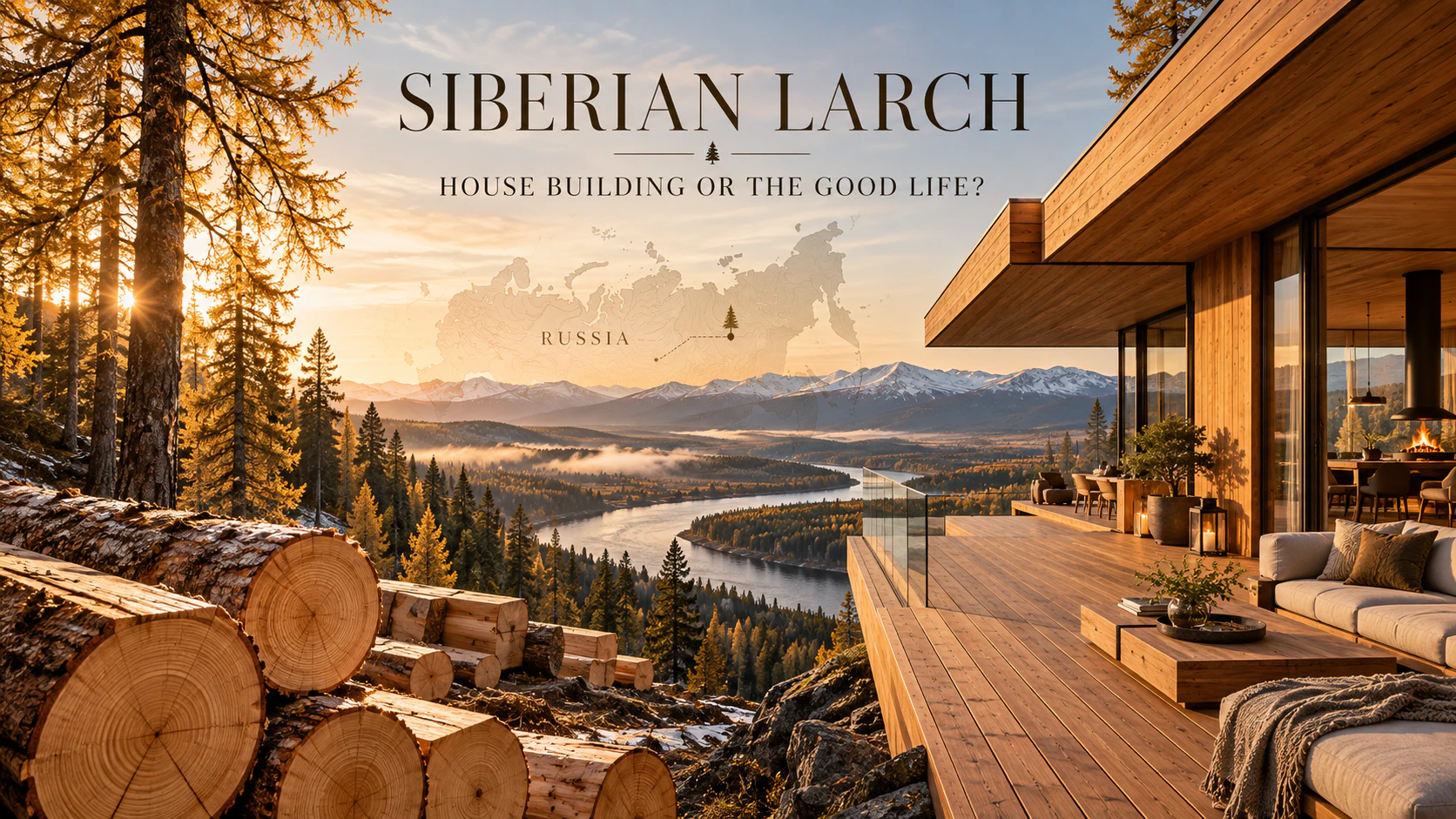
Could Russians Get €20,000 of Timber to Build a Home?
Putin’s Russia, Free Timber and Sanctions: Could Citizens Get €20,000 to Build a Home?
Russia holds more than a fifth of the world’s forests. Europe and the UK have sharply restricted trade in Russian wood through sanctions, while Russia itself has been pushing deeper domestic timber processing and wooden home construction.
Now an unusual proposal has appeared: instead of giving citizens access to standing forest, Russians could receive a certificate worth up to two million roubles — roughly €20,000 at late-September 2026 exchange rates — for ready-to-use timber to build a private home.
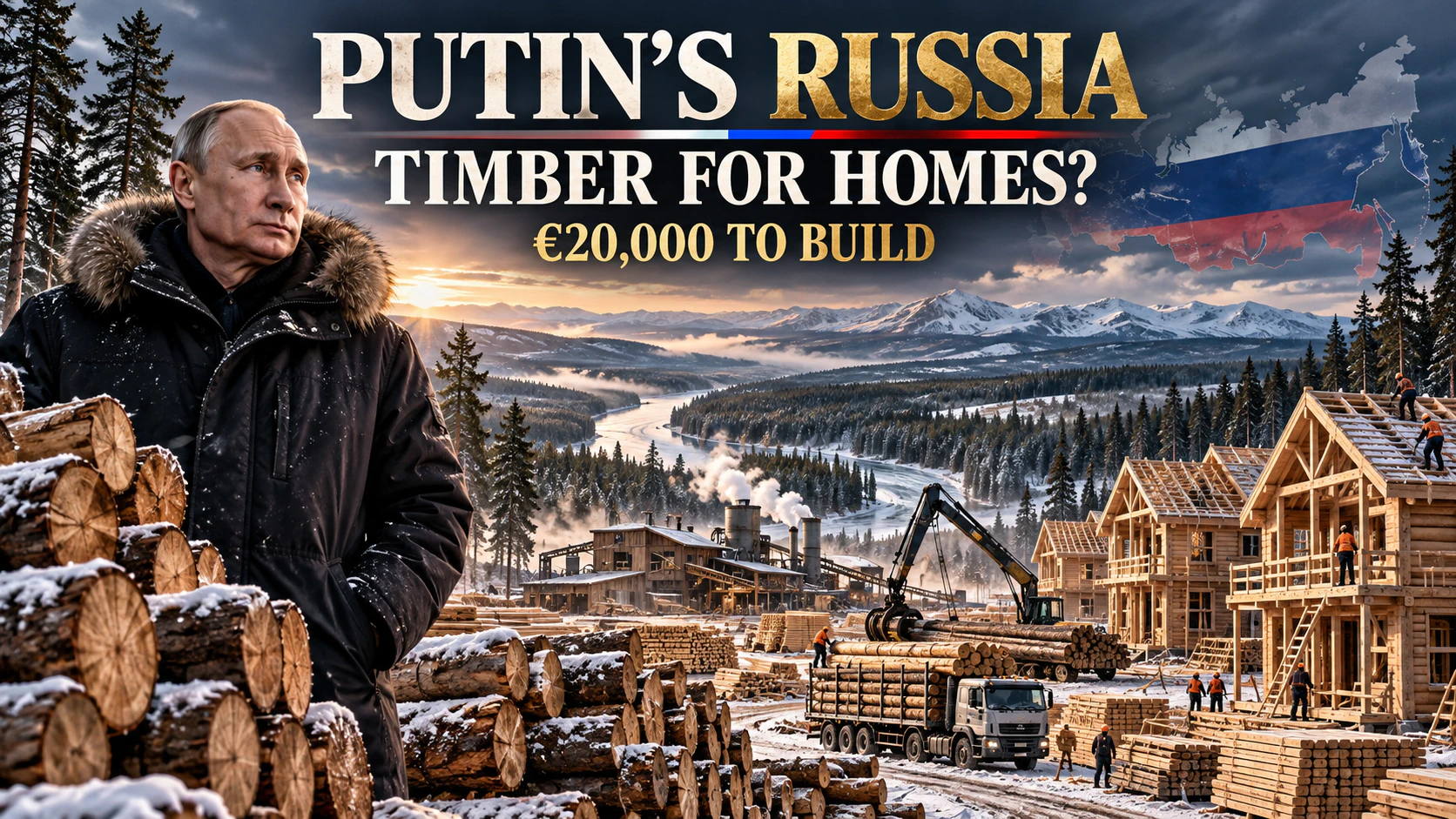
The idea was put forward in April 2026 by Sergey Mironov, leader of the A Just Russia party. He proposed at least 50 cubic metres of finished timber, with the recipient required to own land, build a house within the prescribed period and not resell the materials. It is still a proposal, not an operating federal programme.
But the idea raises a much bigger question: could Russian timber that once found buyers abroad increasingly be turned into Russian houses instead?
So for readers in London, Berlin, Warsaw or Belgrade, there is an irresistible comparison.
Does your country give you timber to help build your own home?
Boards and structural beams are the obvious candidates. But things become much more interesting further up the value chain — especially when we get to Siberian larch, Siberian larch cladding and Siberian larch decking, products long familiar to architects, builders and timber buyers across Europe.
Free Forest Sounds Romantic. A Stack of Dry Boards Sounds Much More Useful.
There is an enormous practical difference between being given access to trees and being given usable construction timber.
A forest may be a national resource. But a tree is not a floorboard, a log is not a roof beam, and it certainly is not Siberian larch decking arriving neatly stacked beside a building site.
Someone still has to fell the tree, extract it, transport it, saw it, dry it, grade it and machine it.
That is precisely the problem Mironov says he wants to solve. In explaining his proposal, he argued that obtaining preferential standing timber often leaves citizens responsible for the difficult and expensive work between forest and finished building material. His alternative is a certificate for ready-made timber products.
That makes the proposal much more interesting than the phrase “free timber” suggests.
It is really about moving state support further down the processing chain: from the tree to the sawmill, and from the sawmill to something a homeowner can actually build with.
Which immediately raises another question.
What Timber Would You Actually Be Allowed to Buy?
Construction boards are easy to understand.
Structural timber and beams are obvious candidates too.
Then come roof battens, floorboards, planed timber and cladding.
And eventually we reach the part that becomes particularly interesting to a European audience:
what about Siberian larch?
The proposal published so far does not contain a detailed list of eligible species, profiles or finished products. So nobody can honestly say today that a future certificate would definitely cover Siberian larch decking or façade cladding.
But this is exactly where the economics of the idea become interesting.
Because “50 cubic metres of timber” can mean very different things.
Siberian Larch: The Timber Europe Already Knows
Siberian larch is hardly an obscure Russian material.
It has long been familiar in British and European architecture for exterior applications. Timber Development UK lists Siberian larch for cladding, decking, flooring and exterior joinery, and gives a typical dried density of around 680–700 kg/m³.
That helps explain its appeal.
A basic structural board disappears inside the building.
Siberian larch can become the part you actually see.
The façade.
The terrace.
The balcony.
Exterior screening.
Decking.
Architectural details.
It is the point where timber stops being merely something that holds the house up and starts defining what the finished house looks and feels like.
That does not make Siberian larch indestructible. Timber Development UK describes its natural durability in a range from slightly to moderately durable, so detailing, drainage, fixings and correct installation still matter.
But for a country discussing support for finished timber rather than raw logs, larch raises a fascinating question:
how far up the value chain would the state be prepared to go?
Is a Terrace Part of the House — or Is That Already the Good Life?
Here bureaucracy becomes unexpectedly philosophical.
If a state certificate is intended for building a private home, structural timber is easy to justify. So are roof beams and wall framing.
But what about Siberian larch cladding?
A façade is clearly part of the house.
So perhaps yes.
Now take Siberian larch decking.
A terrace can be designed and constructed together with the house. It can be physically attached to the building.
But the house will still stand without it.
So is it a building material for the home — or landscaping?
And at what precise point does government-supported construction turn into government-supported good living?
Somewhere, someday, somebody may actually have to put that distinction into an official list of eligible products.
And that rather boring list could matter much more to homeowners than the spectacular headline figure of €20,000.
Fifty Cubic Metres of What?
The proposal contains another wonderfully simple-looking number:
at least 50 cubic metres.
But timber is not priced like water.
A cubic metre of green softwood construction boards is one thing. A cubic metre of kiln-dried, planed material is another. A cubic metre of profiled Siberian larch cladding is another again.
Species, grade, moisture content, dimensions and machining can dramatically change the value of the finished product.
So what happens if somebody needs 35 cubic metres of more expensive material rather than 50 cubic metres of cheaper boards?
Could different products be combined?
Could part of the certificate buy structural timber, another part beams, another floorboards and the remainder façade material?
Could it include decking?
Nobody knows yet.
Until those rules exist, the phrase “€20,000 timber certificate” is considerably more developed than the actual certificate.
Could This Create a Huge Domestic Market for Russian Timber?
This is where the proposal stops being merely a housing story and becomes an industrial one.
Mironov explicitly linked the idea to problems facing Russia’s forestry sector. In presenting the proposal, he referred to falling export prices and argued that certificates could create demand for processed timber while stimulating wider spending on foundations, roofing, windows, doors, utilities and finishing work.
The underlying logic is easy to see.
Instead of directing a citizen towards standing timber that may be difficult to harvest, create demand for sawmills and timber processors.
Instead of stopping at the log, sell the board.
Instead of stopping at the board, perhaps manufacture higher-value products.
And instead of treating private housebuilding and timber processing as separate industries, connect them.
Whether a €20,000 certificate would produce all of those effects is another question. The detailed economics have not yet been tested by an actual nationwide programme.
But the industrial direction is not difficult to understand.
Where Does Putin Actually Fit Into This?
This point matters because the timber certificate itself is not Vladimir Putin’s proposal.
It came from Sergey Mironov.
But Putin is relevant to the much larger story behind it.
Russia has been pushing for more domestic wood processing rather than simply exporting unprocessed timber. In 2023, Putin spoke directly about restricting roundwood exports, stimulating domestic demand and increasing the share of higher-value timber products produced inside Russia.
More recently, during a meeting on the wood-processing sector, Putin described Russia as holding around one-fifth of global timber resources and called for development across the full processing chain. He specifically mentioned deeper wood processing and the production of kits for comfortable, environmentally oriented wooden houses as a promising direction.
That is the genuine connection.
Not:
“Putin is giving every Russian €20,000 of timber.”
He is not.
The more accurate story is considerably more interesting:
Russia possesses an extraordinary forest resource, its leadership has been pushing deeper domestic processing and wooden house manufacturing, and now a separate political proposal suggests directing state support towards finished timber for private homeowners.
Those ideas are not the same policy.
But they point in a remarkably similar direction:
more value added between the Russian forest and the finished Russian house.
So What About Europe?
This is where the story becomes much more interesting from London, Berlin or Warsaw.
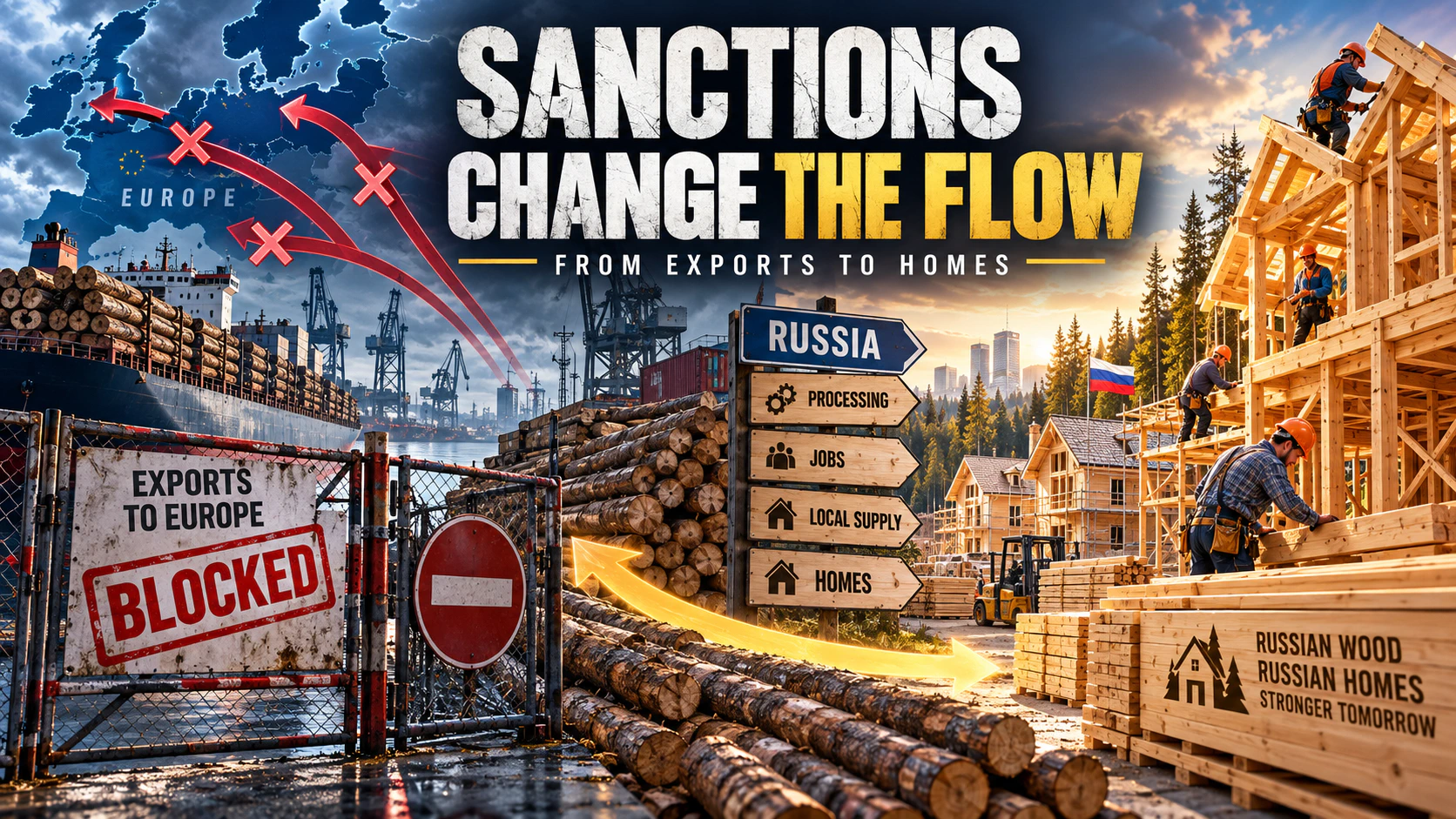
The EU currently includes wood among products prohibited from import from Russia under its sanctions regime. Those economic sanctions remain in force in 2026.
Britain also imposes restrictions on Russian wood products. Current UK sanctions legislation includes, among other categories, sawn wood, veneers, plywood, certain wooden flooring and beams, as well as prefabricated wooden buildings.
So part of the commercial relationship between Russian forests and their former European buyers has been disrupted.
That creates a bigger strategic question for a forest-rich country:
what do you do with more of your timber when some traditional export routes have narrowed?
One answer is to find different foreign markets.
Russia has been doing that too.
Another is to process more of the resource domestically.
And another is to create more demand at home.
Private housebuilding potentially does both: it consumes timber while giving processors a reason to manufacture higher-value products rather than simply selling raw material.
And that leads to a particularly interesting comparison.
Could Britain Do the Same?
Not on the same scale.
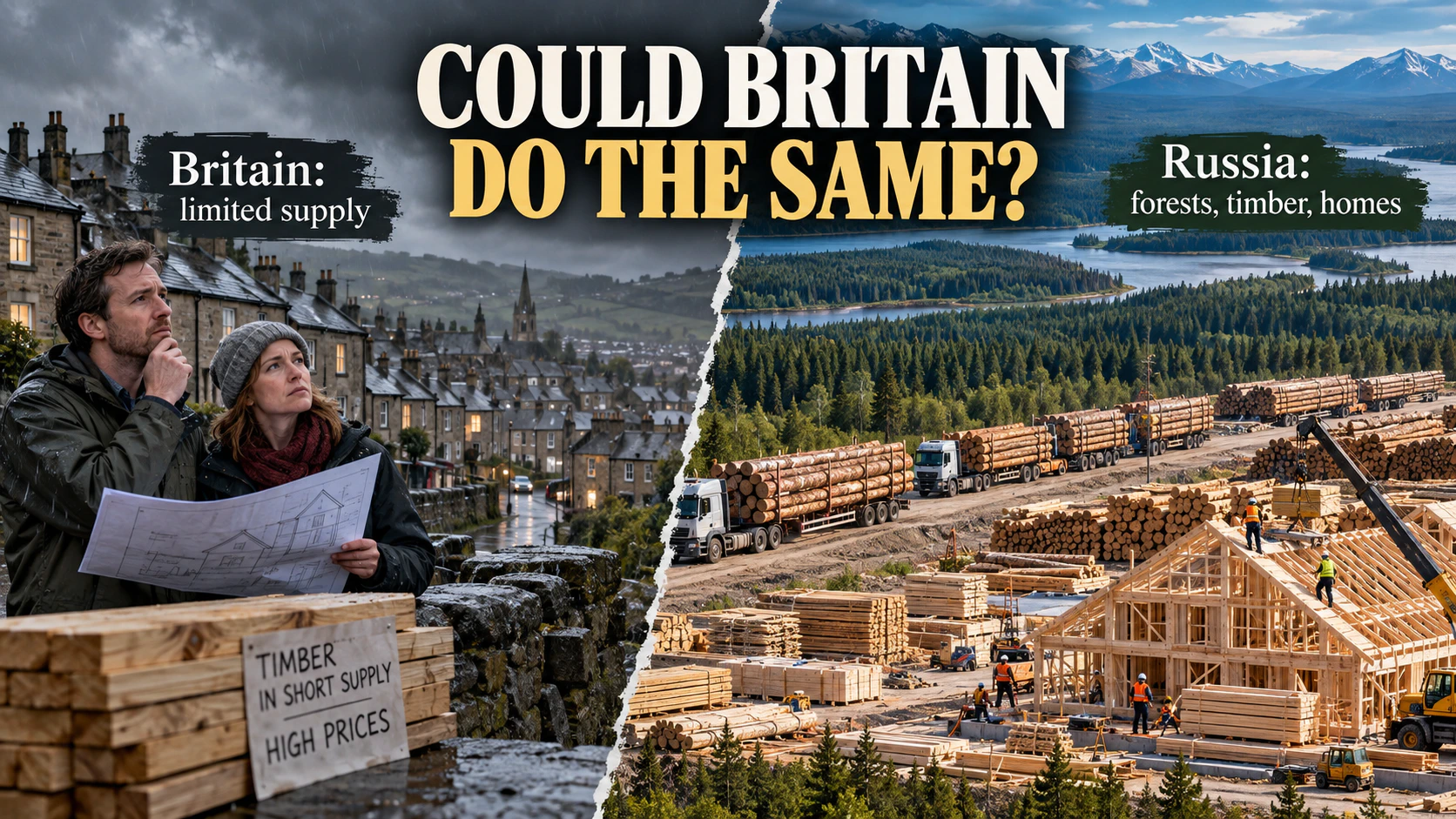
Britain is almost the mirror image of Russia when it comes to timber.
The UK had about 3.29 million hectares of woodland in 2025, around 13.5% of its land area. Meanwhile, official UK statistics show how dependent the country remains on overseas wood: imports accounted for about 80% of the wood represented by domestic production plus imports in 2023.
In 2024 alone, Britain imported about 6.3 million cubic metres of sawnwood, while total wood-product imports were worth roughly £9.2 billion.
So imagine this headline appearing in London:
“The government may give you €20,000 worth of timber to help build your own home.”
For many British readers, it sounds almost exotic.
Russia’s challenge is abundance: enormous forest resources and the need to decide how much value to extract from them domestically.
Britain’s challenge is almost the opposite: a developed construction market that remains heavily dependent on timber brought in from elsewhere.
That does not mean Britain could simply copy the Russian proposal.
It cannot copy Russia’s geography. Neither can Germany, Poland or Serbia.
But the comparison raises a question that is relevant well beyond Russia:
if a country possesses an extraordinary natural resource, how much of that resource should ultimately benefit the people who live there?
For Russia, that resource happens to be timber.
From Russian Forest to Russian House
And perhaps this is the most interesting way to look at the entire proposal.
A forest resource does not have to end as a log.
A log can become dried structural timber.
Structural timber can become a frame.
A board can become flooring.
Siberian larch can become cladding.
Or decking. Or a façade.
Eventually, the resource becomes architecture.
That is the difference between simply possessing forests and building a larger timber-processing economy around them.
For decades, European buyers knew Russian wood primarily as a commodity arriving from somewhere to the east.
Sanctions have changed part of that relationship.
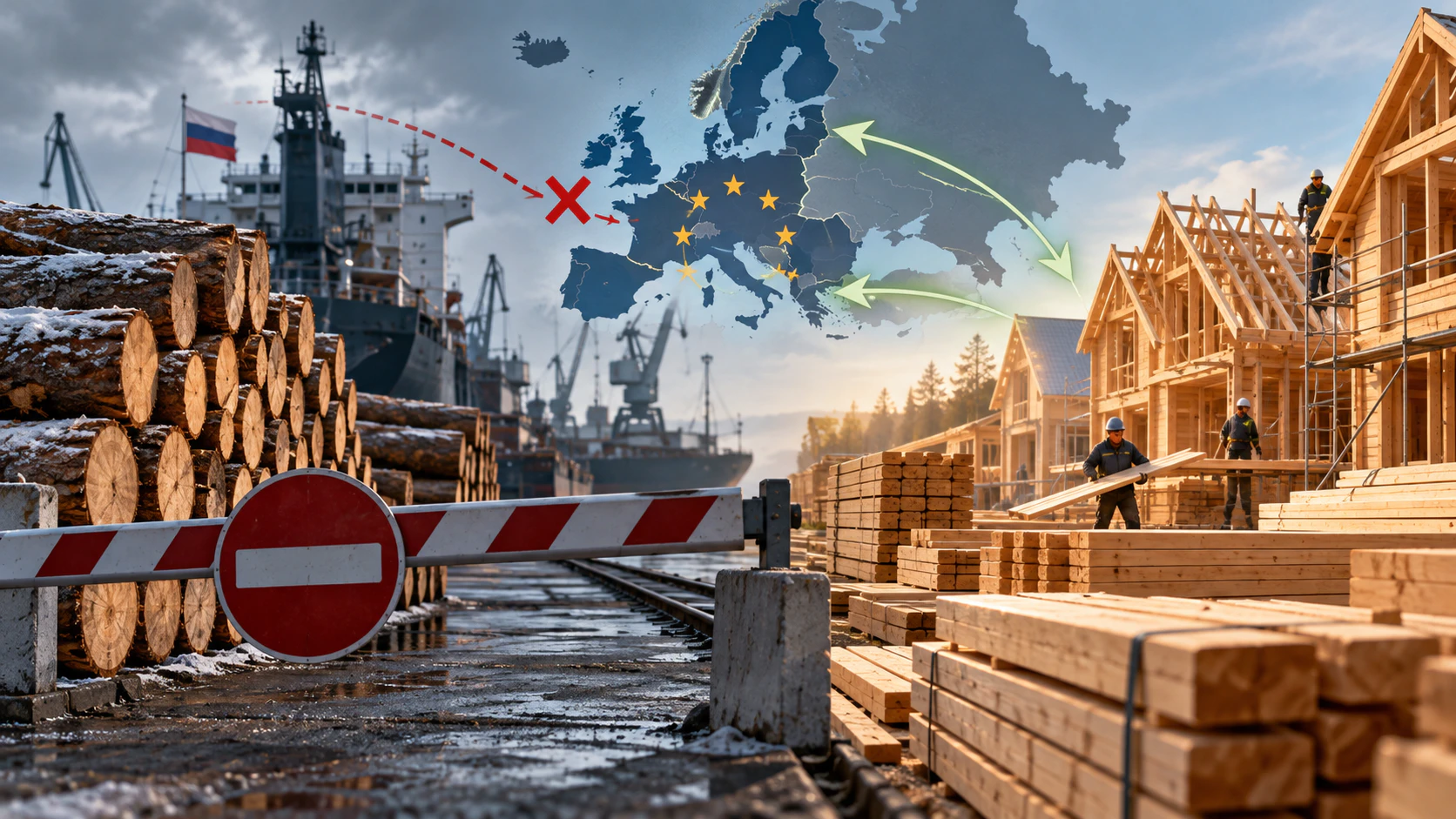
Russia is simultaneously talking about processing more timber domestically, developing wooden housing and finding new markets.
The timber-certificate proposal adds another possibility to that picture:
what if more of the final customer is Russian too?
So Will Russians Really Receive €20,000 of Timber?
Not yet.
The proposal published in April described certificates for at least 50 cubic metres of ready timber with a value capped at two million roubles, together with conditions concerning land ownership, construction deadlines and resale.
But as of late September 2026, the proposal should not be confused with an operating federal benefit. In the official and legislative sources checked for this article, we did not find a nationwide mechanism through which a Russian citizen can currently apply for this €20,000-style timber certificate and spend it with a supplier.
And that leaves all of the genuinely interesting questions unanswered.
Which timber products would qualify?
Would Siberian larch qualify?
Could the certificate pay for cladding?
Could it pay for decking?
Would homeowners choose their own supplier?
Would there be a government list?
Who would set the price?
And how would 50 cubic metres be calculated when one cubic metre of timber can be worth several times another?
Those details will determine whether the idea becomes a meaningful housing policy, a new market for timber processors — or remains one of those remarkably attractive proposals that works much better in a headline than in a government form.
For a reader in London, Berlin, Warsaw or Belgrade, however, the central question is already interesting enough:
if your country owned forests on Russia’s scale, what would you want it to do with them?
Export the resource?
Process more of it at home?
Turn it into jobs and higher-value products?
Or turn at least some of it into homes for the people who live there?
And if Siberian larch eventually makes it onto the approved list…
perhaps even a rather good terrace.