Navigating Russia's Timber Industry: The Interplay of Government Support and Sectoral Obstacles
Balancing Industry Needs and State Budget: A Look into Russia's Forestry Subsidies
In an ever-evolving economic landscape, a nation must consistently evaluate the balance between industry needs and the capacity of its state budget. The situation with the Russian timber industry is a vivid example of this delicate equilibrium, demonstrating the importance of optimising the subsidy process and the urgency of timely support measures to evade negative implications.
Russian Government Support Measures
Expansion of Support for Forestry Companies
In an effort to bolster the timber industry, the Russian government recently announced an increase in its support measures. These include raising the compensation of transport costs for the export of timber products through Northwest ports from 80% to a full 100% by June 30, 2023. This decision underlines the government's commitment to aid the industry through difficult times.
Historical Overview of the Compensation Scheme
This decision follows Prime Minister Mikhail Mishustin's approval of a regulation in July 2022. This regulation allowed timber companies to receive compensation of up to 80% of the cost of transporting products for export through all ports. However, the compensation was capped at 25% of the product value, and each company could receive a maximum of 500 million rubles.
New Increase in Compensation
The new expansion in support measures is a significant step in addressing the challenges faced by the timber industry. The increase to full compensation of transport costs aims to ensure that the industry remains viable amidst shifting economic conditions.
Challenges in Subsidy Optimization
Putin's Intervention
In response to industry concerns and following a meeting on the timber industry in February 2023, President Vladimir Putin called for a review of the subsidy process. He tasked the government and the Russian Export Centre (REC) to work on proposals to optimize the subsidy scheme.
Improving the Subsidy Process
This process requires a careful re-evaluation of the existing subsidy measures, ensuring they are well targeted, cost-effective and in line with the industry’s needs. The ultimate aim is to design a system that provides adequate support without straining the state budget.
Subsidy Budget vs Industry Needs
Subsidy Budget Shortfall
Despite the positive step towards improving subsidies, there remains a stark gap between the available funding and the actual needs of the industry. In 2022, the demand for compensation more than doubled the budget set aside for this purpose. The stated need for the second half of 2022 alone exceeded 15 billion roubles, a figure far beyond the allocated 7.7 billion roubles for the timber, metals, and chemicals sector.
Industry Reactions
Such a shortfall raises concerns within the industry, leaving many wondering whether the state will be able to fulfill its promises of support. There is a clear need for further measures to be taken to bridge this gap and ensure the sustainability of the sector.
An Analytical Perspective
Importance of Subsidies
From an analytical viewpoint, subsidies are critical in supporting domestic exporters, particularly given the challenges of falling prices and expanding supplies to China. The role of subsidies becomes even more crucial in the face of intensifying sanctions which have led to a 90% reduction in timber product exports to the West.
Sanctions and Export Decline
The combination of these sanctions and the shift in the global economy has put a tremendous strain on the Russian timber industry. There is an urgent need for the government to step up and provide meaningful support to help this vital sector navigate these tumultuous times.
Conflict in Subsidy Strategy
However, it's worth noting the apparent inconsistency in the government's approach. Analysts have observed that the increase in subsidies for shipments of forest products through Northwest ports seems at odds with simultaneous reductions in subsidies for shipments to the Far East. This paradox needs addressing if the subsidy scheme is to be truly effective.
Lack of State Support: Concerns in the Forestry Sector
Worries in Russia's Timber Industry
Major players in Russia's timber industry are expressing dissatisfaction over insufficient state support. Deputy Prime Minister Victoria Abramchenko has been at the receiving end of these complaints. Measures promised during a meeting in February with President Vladimir Putin have not been fully executed. Salient issues remain unresolved, such as deferral of forest lease payments, an increase in transport subsidies for exports, and improvements in logistics infrastructure. The industry is feeling the pinch as losses accumulate and state aid falls short, especially following the imposition of sanctions.
Protecting the Interests of the Timber Industry: Proposals from Regional Representatives
According to Kommersant, representatives from Arkhangelsk, Vologda, Kostroma, and Karelia have proposed ways to stabilize the timber industry following a joint meeting. They sent a letter to Deputy Prime Minister Viktoria Abramchenko, reminding her that the promises made by President Putin during the February 10 meeting have not yet been fully actualized.
The Road to Stabilisation: LPC Demands
Companies involved in the forestry sector are urging the government to expedite the adoption process of the draft decree drafted by the Ministry of Natural Resources. This draft suggests that, in 2023, forestry companies will be able to pay for the lease of forest plots based on actual timber harvesting volumes. This, they argue, would help alleviate some of the financial pressures they currently face.
Future Plans: Changes in Lease Terms
Key players in the industry are suggesting further changes to lease terms. They are advocating for a moratorium on indexation of leasing rates, scheduled to increase by 4.6% in 2024. Additionally, they propose postponing the implementation of new rules for calculating lease payments until January 1, 2026. Both of these measures would provide additional breathing room for the industry amidst current economic challenges.
Strengthening Support for Exports: Demand for Transport Subsidies
Finally, there are loud calls from the industry for a significant increase in transport subsidies to support exports. Given the integral role of exports in the Russian timber industry, enhancing transport subsidies would be a significant step towards bolstering the industry’s strength and resilience in these tough times.
Increasing Subsidies: A Pressing Need
Participants in the meeting have repeatedly highlighted the need for increased subsidies for timber transportation for exports, particularly for enterprises in the North-West. For instance, six leading timber industry enterprises in the Arkhangelsk region applied for subsidies. However, the total funds allocated amounted to a mere 1.5 billion rubles, while the requirement stands at 10 billion rubles. The companies also emphasize the urgency to increase the frequency of vessel calls at the ports of the Baltic basin.
Impact of Sanctions on the Marine Fleet
Sanctions have created significant problems for the Russian maritime fleet, with most available ships registered in countries where Russia has not entered into double taxation agreements. This has resulted in producers acting as tax agents for foreign shipowners when chartering a vessel, having to pay a 10% tax on the value of the charter. As a result, there are recommendations to temporarily nullify this tax rate.
Opinion of Industry Experts
Nikolay Ivanov, vice-president of Segezha Group, stated that the company was part of drafting the appeal to Victoria Abramchenko. Ivanov stressed that their holding had encountered similar problems at their Siberian assets in the Irkutsk Region and Krasnoyarsk Territory, particularly with railway logistics.
Problems with Rail Logistics
Ivanov further commented on the paradoxical situation with rail logistics, stating, "It's cheaper for us to ship to China from Onega in the Arkhangelsk Oblast than from Lesosibirsk or the Irkutsk Oblast, which are geographically closer to China."

Business Realities: Industry under Sanctions
Anton Zebants, general director of the Vologda group of companies VLP, noted that most timber companies operated at a loss in the second half of 2022. Despite some reaching break-even in the first quarter due to low winter logging costs and a weakening ruble, the situation remains precarious. For example, in the Vologda region, logging volumes have dropped by 17%, and plywood production has decreased by 25%.
Proposals to Support the Industry
Zebants emphasizes that given the inaccessibility of European markets and the current tense state of affairs, the discussed support measures for the industry need to be implemented swiftly to avoid grave consequences. Dmitry Gvozdev, CEO of Region-Les LLC, concurred, saying, "The industry has been under sanctions for almost a year now, and the current support measures are still insufficient."
To summarize, the importance of supporting domestic sawn timber producers cannot be overstated. Given the current global market and political situations, this support has become not only important, but crucially vital.
Supporting the Domestic Economy through Timber
Today, purchasing sawn timber directly from manufacturers goes beyond the transaction itself. It becomes a meaningful contribution to the development of the domestic economy, fostering job creation and preservation. Quality lumber, available in Moscow and other cities across the country, serves as an essential cornerstone for the thriving construction industry, ultimately contributing to comfortable living conditions for citizens.
Competitiveness and Accessibility
Here at Timber Expert, we pride ourselves on delivering excellent quality at an accessible price. Our lumber and edged boards are competitively priced, reflecting our dedication to providing superior domestic timber to the broadest possible audience. Every purchase from us isn't just a testament to the value we offer, but also a significant contribution to supporting our domestic production.
Facing Challenges Head-on: Timber Export under Sanctions
Curious about how we at Timber Expert navigate the export of larch sawn timber amidst sanctions? Intrigued by how politics influences the price of a cubic board and who truly bears the brunt of the sanctions? Maybe you'll be surprised by the price difference of larch lumber between Europe and Turkey. Our article, "Board Cube and Sanctions: The Price Difference of Larch Lumber Between Europe and Turkey!", provides answers to these questions and more!
Exporting Far and Wide: Open to All Countries
We are open for business with all countries. Whether it's the United Arab Emirates, Iran, Saudi Arabia, Turkey, Tajikistan, Uzbekistan, or Kazakhstan, we welcome collaborations with open arms. Our Russian timber is available for export, and we are eager to foster international cooperation.
Are you curious about how we at Timber Expert navigate the export of larch lumber amidst sanctions?
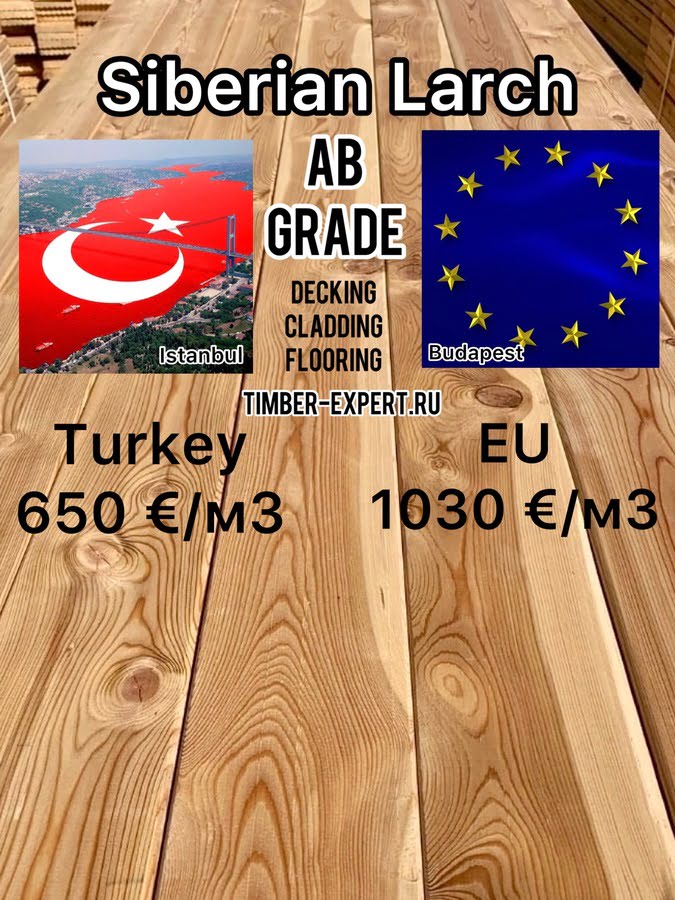
Intrigued about the political implications on the cost of each cubic board, and wondering who bears the brunt of these sanctions? You might even be startled by the disparity in the pricing of larch lumber between Europe and Turkey. If these questions pique your interest, we suggest diving into our enlightening article, "The Wood War: Europe vs. Turkey - Revealing Price Disparities in Siberian Larch Amid Sanctions and Substantial Discounts".
Rallying for Our Producers
Let's stand in support of our producers. Let's place our trust in the quality and reliability of Russian lumber. Your support plays a pivotal role in the stable and successful development of Russian timber companies. Together, we can ensure the continued prosperity of our industry.
Team, Timber Expert