How Many Boards Are in a Cubic Metre? Why 22, 22.22 and 23 Can All Be Correct
How Many Boards Are in a Cubic Metre? Why 22, 22.22 and 23 Can All Be Correct
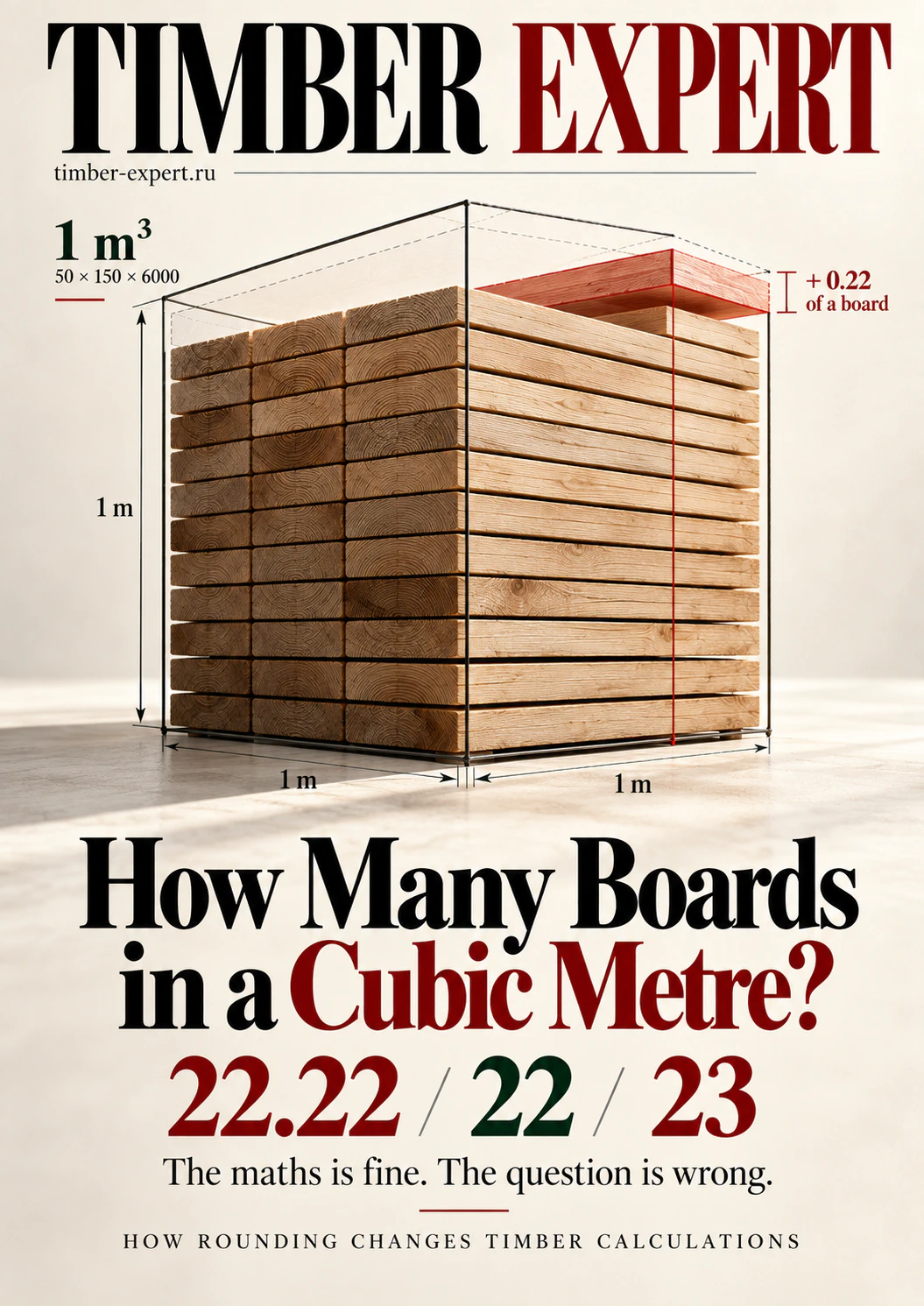
Some questions get answered online with such confidence that you might think every timber website agreed on the number beforehand. Ask how many 50×150×6000 mm boards there are in one cubic metre and you will quickly find the answer: 22.
Sometimes 23.
Sometimes 22, 22.
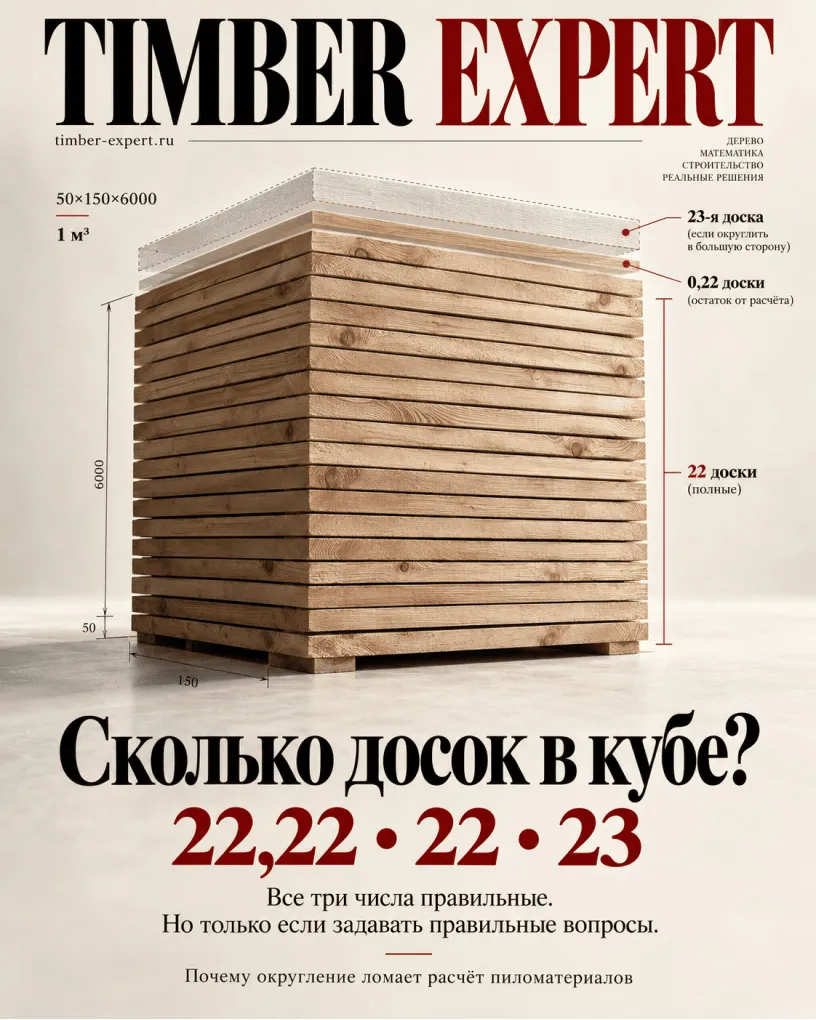
So here is the interesting part: all three numbers can be correct — but only if you are asking the right question. That is where much of the confusion around timber volume begins. A calculated figure gets rounded, the rounded number is then used in the next calculation, and after a few repetitions nobody remembers what the original number actually meant.
So we are going to do this differently.
First we will calculate the numbers ourselves. Then we will check them in reverse. After that, we can use the tables without having to take anybody's word for it.
This guide comes from a timber-processing business, so occasionally we are going to be a little more particular than most online calculators.
Don't worry.
The mathematics never gets beyond multiplication and division.
How to Calculate Timber Volume
For a rectangular sawn board, you need three dimensions: thickness × width × length
Convert all three dimensions to metres and multiply them.
For a 50×150×6000 mm board:
50 mm = 0.05 m
150 mm = 0.15 m
6000 mm = 6 m
The volume of one board is:
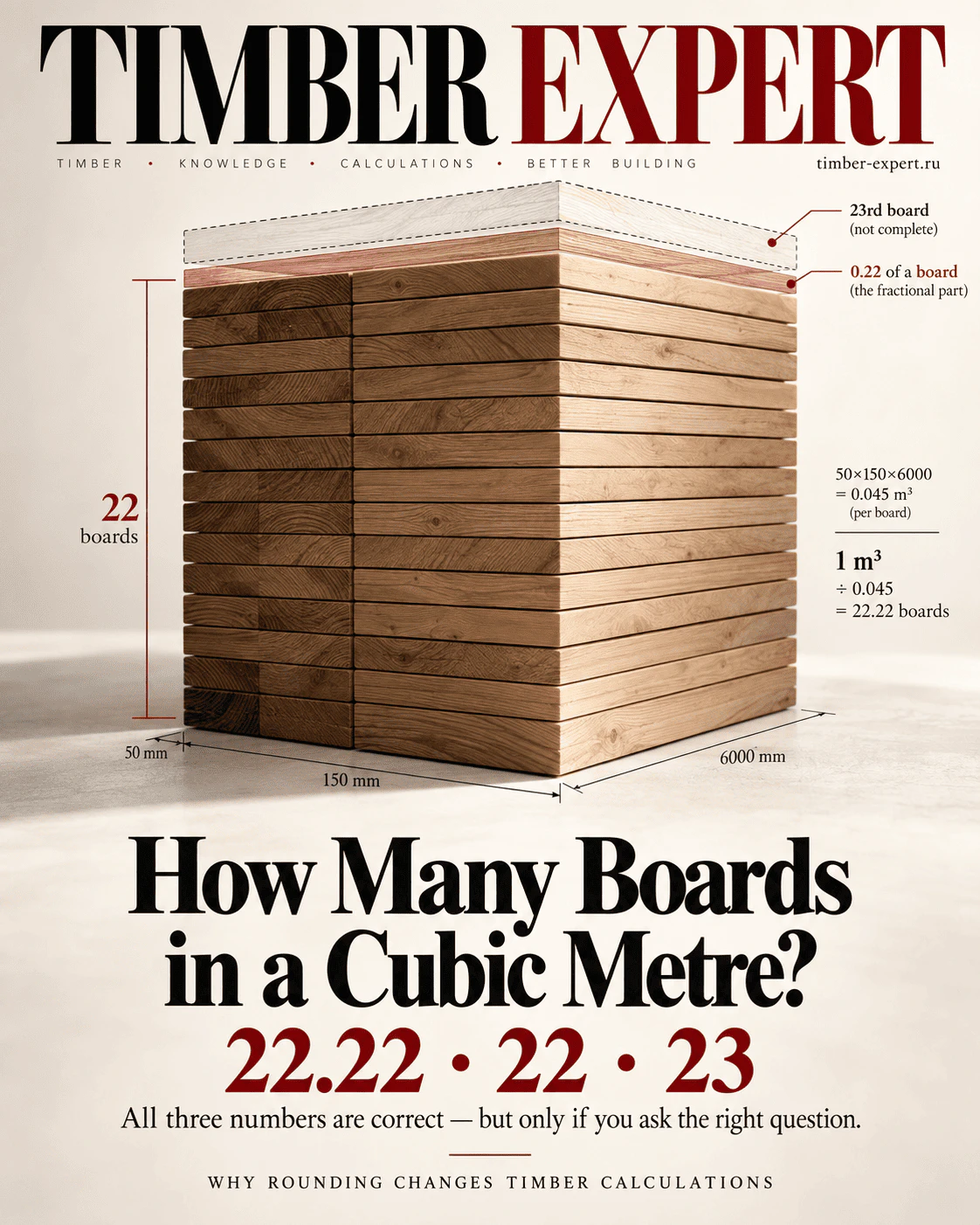
0.05 × 0.15 × 6 = 0.045 m³
Now divide one cubic metre by the volume of one board:
1 ÷ 0.045 = 22.222... boards/m³
And this is where things become interesting.
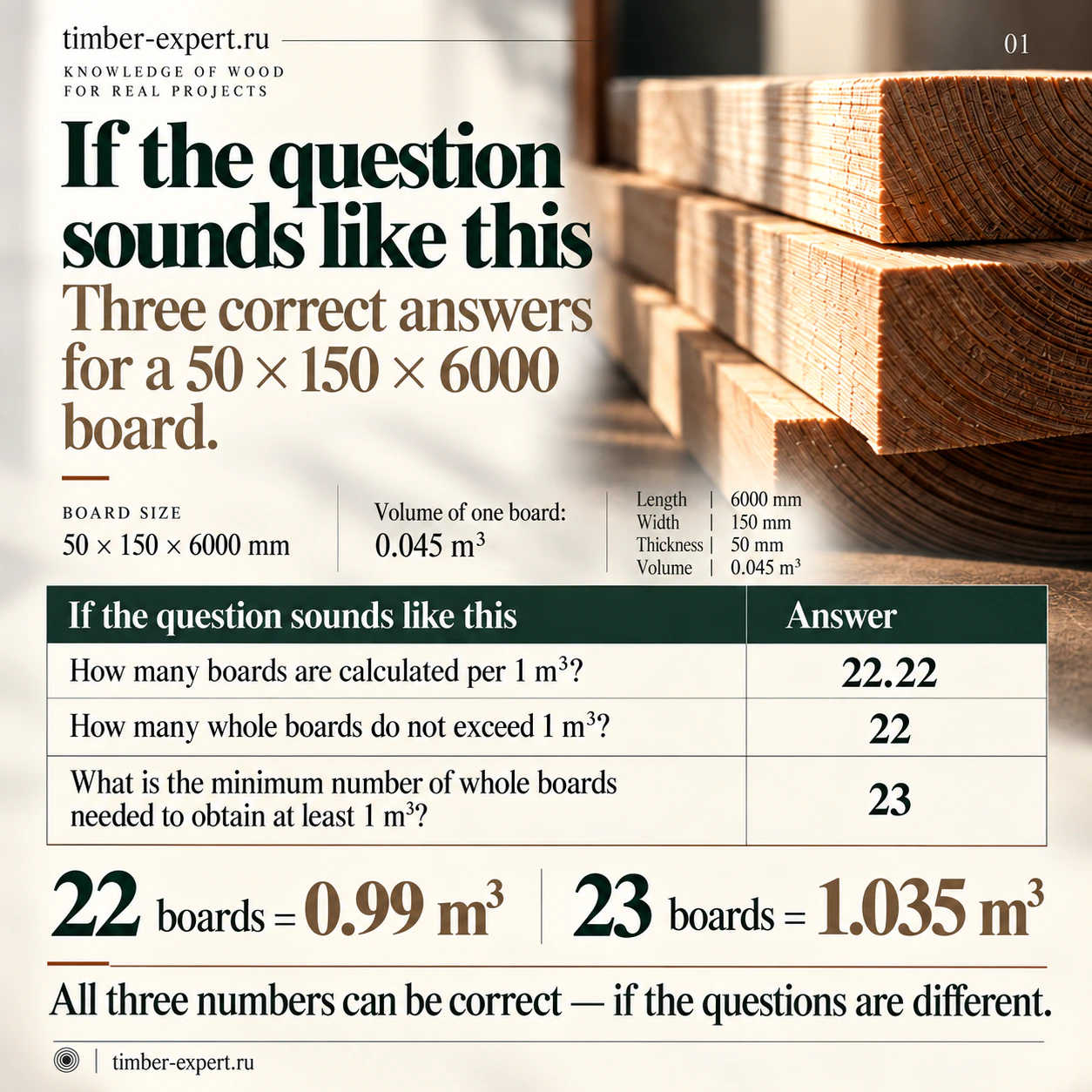
If the question is: “What is the calculated number of boards per cubic metre?”
the answer is: 22.22 boards/m³
If the question is: “How many complete boards can I have without exceeding 1 m³?”
the answer is: 22 boards
because:
22 × 0.045 = 0.99 m³
But if the question is:
“What is the minimum number of complete boards required to reach at least 1 m³?”
the answer is:
23 boards
because:
23 × 0.045 = 1.035 m³
The mathematics was never the problem.
The question was.
Three correct answers for 50×150×6000 mm timber: 22.22, 22 and 23
Timber Cubic Metre Table
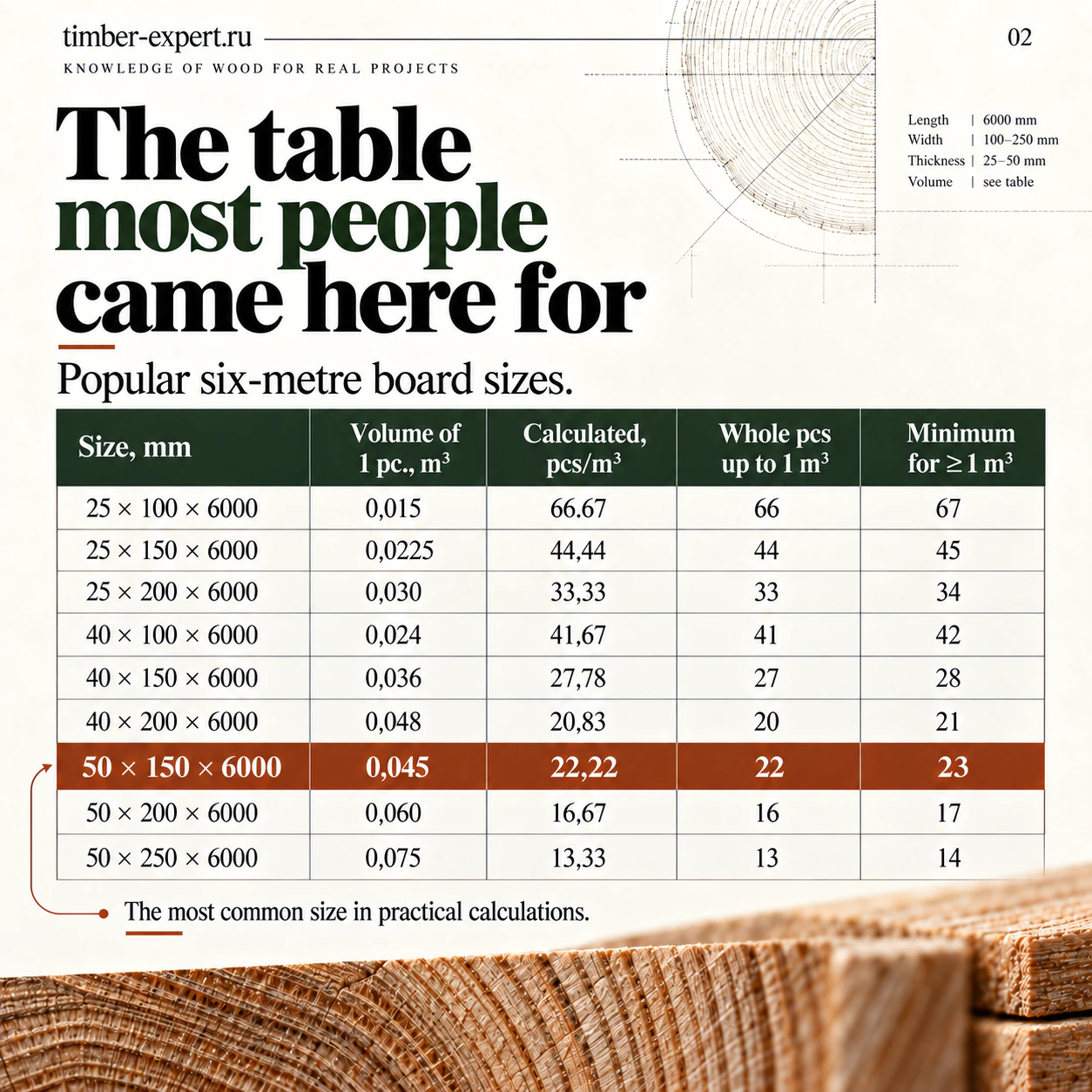
Most people, of course, did not come here for a philosophical discussion about rounding. They came for the table. Fair enough.
For the most common 6 metre metric sizes, we calculated:
- volume of one board;
- calculated pieces per cubic metre;
- maximum whole-board count below 1 m³;
- minimum whole-board count reaching or exceeding 1 m³.
The figures are calculated directly from the dimensions rather than copied from another timber table.
Quick timber volume table for common 6 m board sizes
There is one distinction worth remembering:
22.22 boards/m³ is a mathematical ratio.
22 complete boards are a physical quantity with a volume of 0.99 m³.
Those are not quite the same thing.
How Many 50×150×6000 Boards Are in a Cubic Metre?
Let us start with the size that seems to have taught half the internet the phrase “cubic metre of timber”.
For 50×150×6000 mm:
0.05 × 0.15 × 6 = 0.045 m³
Then:
1 ÷ 0.045 = 22.22 boards/m³
So:
22.22 boards/m³ — calculated ratio;
22 boards = 0.99 m³;
23 boards = 1.035 m³.
Which brings us back to the familiar argument:
“So is it 22 boards in a cubic metre or 23?”
It is a little like arguing about how many people fit in a car when one person is asking how many seats it has and the other is asking how many passengers must get in before every seat is occupied.
First agree on the question.
How Many 25×150×6000 Boards Are in a Cubic Metre?
For 25×150×6000 mm:
0.025 × 0.15 × 6 = 0.0225 m³
Therefore:
1 ÷ 0.0225 = 44.44 boards/m³
So:
44 boards = 0.99 m³;
45 boards = 1.0125 m³.
Again, the number from the “boards per cubic metre” column should not automatically be treated as a physical board count.
How Many 40×150×6000 Boards Are in a Cubic Metre?
For 40×150×6000 mm:
0.04 × 0.15 × 6 = 0.036 m³
Then:
1 ÷ 0.036 = 27.78 boards/m³
Therefore:
27 boards = 0.972 m³;
28 boards = 1.008 m³.
How Many 50×200×6000 Boards Are in a Cubic Metre?
For 50×200×6000 mm:
0.05 × 0.20 × 6 = 0.06 m³
Then:
1 ÷ 0.06 = 16.67 boards/m³
So:
16 boards = 0.96 m³;
17 boards = 1.02 m³.
The larger the cross-section, the fewer 6 metre pieces there will be per cubic metre.
Nothing mysterious is happening here.
Just geometry behaving itself.
How Many 25×100×6000 Boards Are in a Cubic Metre?
For 25×100×6000 mm:
0.025 × 0.10 × 6 = 0.015 m³
Then:
1 ÷ 0.015 = 66.67 boards/m³
So:
66 boards = 0.99 m³;
67 boards = 1.005 m³.
And yes, 0.99 m³ appears suspiciously often.
No conspiracy among timber merchants is required.
Many common timber dimensions simply produce a fractional number of pieces per cubic metre.
Complete 6 Metre Timber Volume Table
For a wider range of dimensions, use the extended table below.
Complete cubic metre table for 6 metre timber
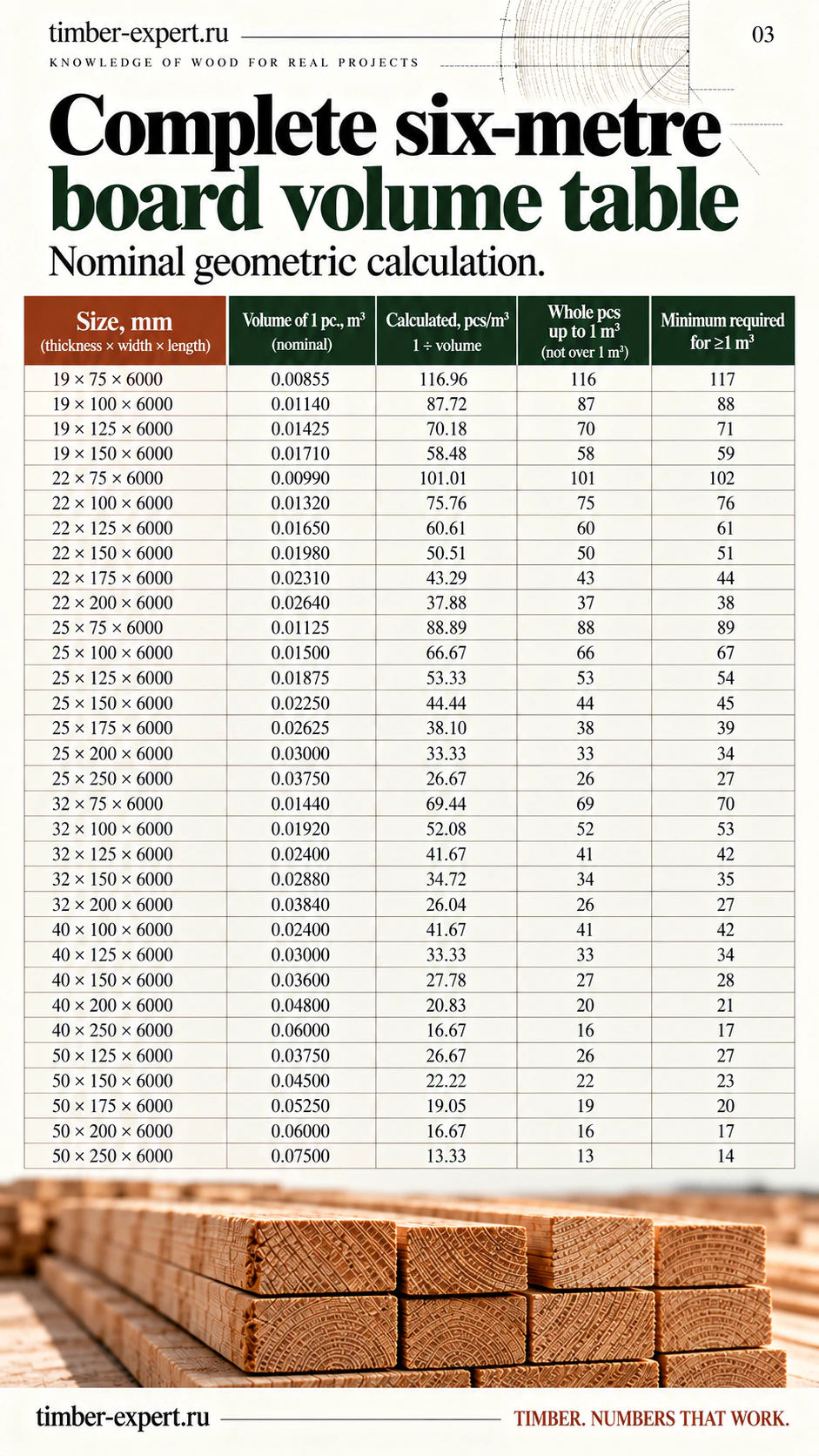
The values show the nominal volume of one piece and the calculated number of pieces per cubic metre.
There is no standard that magically declares that one cubic metre contains 22, 44 or 66 boards.
The number comes from:
1 ÷ volume of one piece
Nominal Timber Size Is Not Always the Actual Finished Size
This point matters particularly for an international audience.
A dimension such as 50×150 mm is often a nominal sawn size.
Finished, planed or regularised timber may measure less after drying and machining. UK timber calculators and merchants also distinguish between nominal and finished dimensions, and common UK structural sections may be quoted at finished sizes such as 47×150 mm rather than 50×150 mm. Trade Pro
So before ordering, always check whether the supplier's dimensions are:
nominal sawn dimensions
or
actual finished dimensions.
Our tables use the dimensions written in the size itself.
In other words, 50×150×6000 mm is calculated as 50×150×6000 mm.
How Many 3 Metre Boards Are in a Cubic Metre?
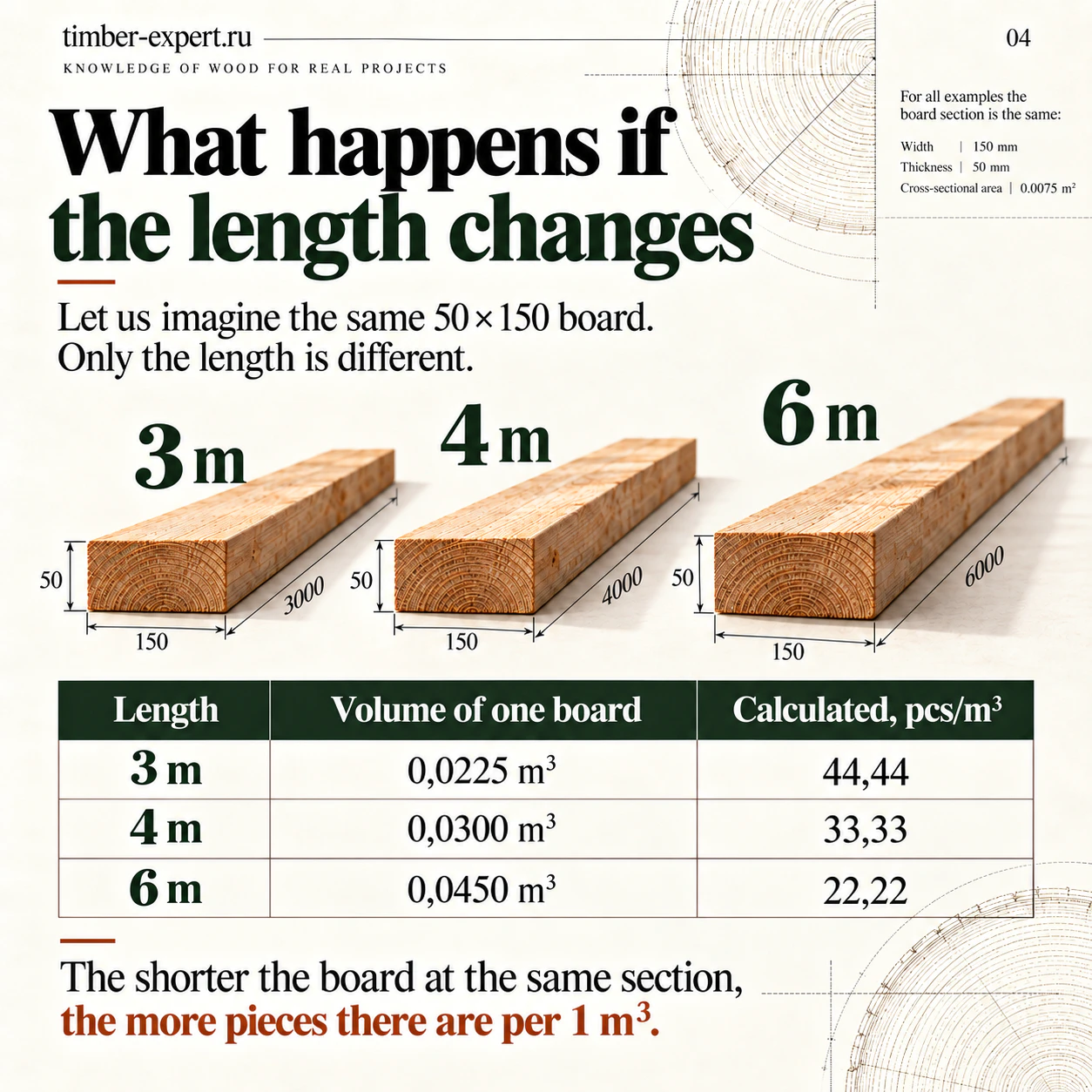
Keep the same cross-section — 50×150 mm — and change only the length.
For a 3 m board:
0.05 × 0.15 × 3 = 0.0225 m³
1 ÷ 0.0225 = 44.44 boards/m³
For a 4 m board:
0.05 × 0.15 × 4 = 0.03 m³
1 ÷ 0.03 = 33.33 boards/m³
For a 6 m board:
0.05 × 0.15 × 6 = 0.045 m³
1 ÷ 0.045 = 22.22 boards/m³
So with the same cross-section, there are mathematically twice as many 3 metre boards per cubic metre as 6 metre boards. Which is only fair. Each one is half as long.
50×150 mm timber at 3 m, 4 m and 6 m lengths
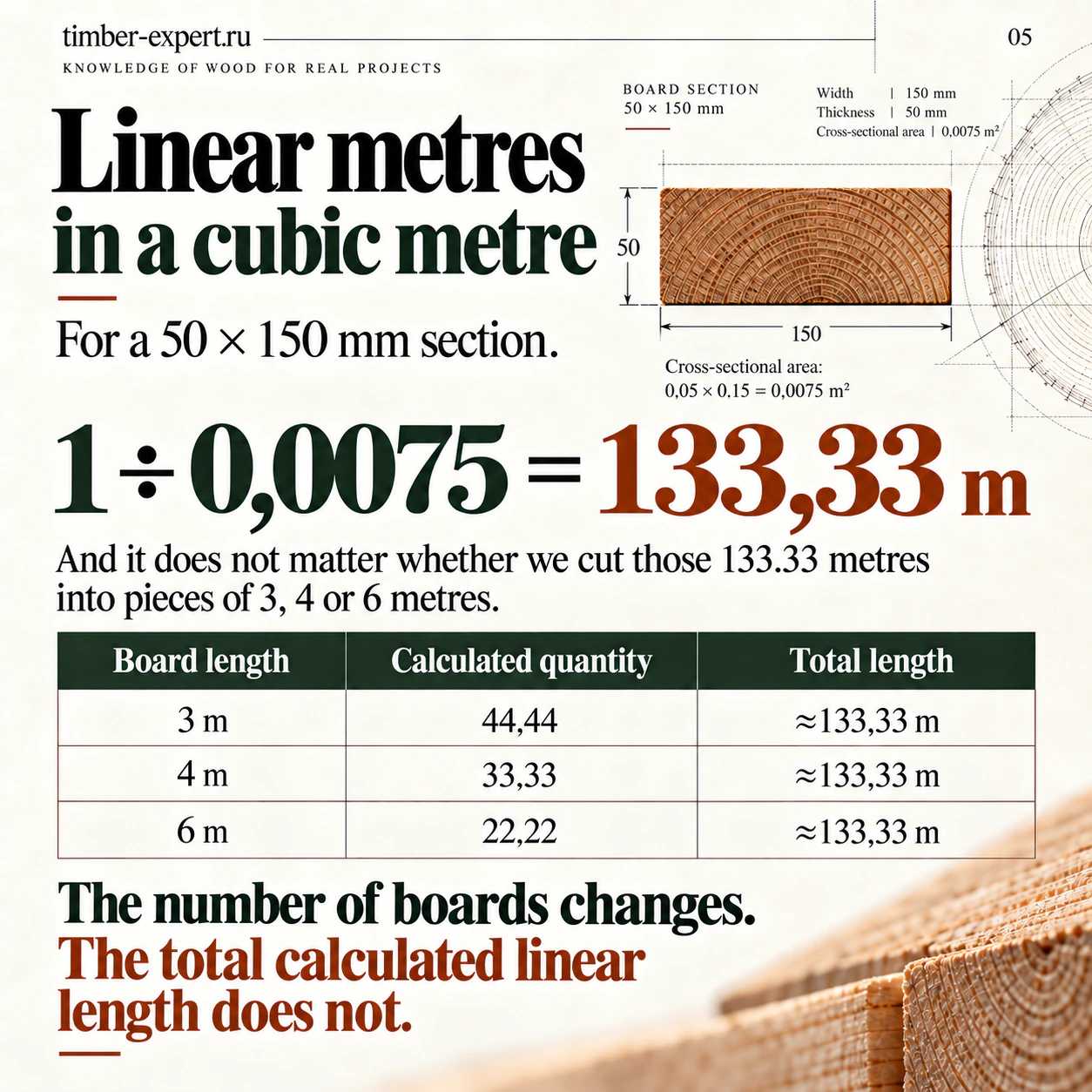
How Many Linear Metres of Timber Are in One Cubic Metre?
Here is a surprisingly useful calculation. The cross-sectional area of 50×150 mm timber is:
0.05 × 0.15 = 0.0075 m²
Now divide one cubic metre by that cross-sectional area:
1 ÷ 0.0075 = 133.33 linear metres
And it does not matter whether those 133.33 metres are cut into 3 m, 4 m or 6 m pieces. The number of pieces changes. The total calculated linear length does not.
Linear metres in 1 m³ of 50×150 mm timber
How Many Square Metres of Timber Are in One Cubic Metre?
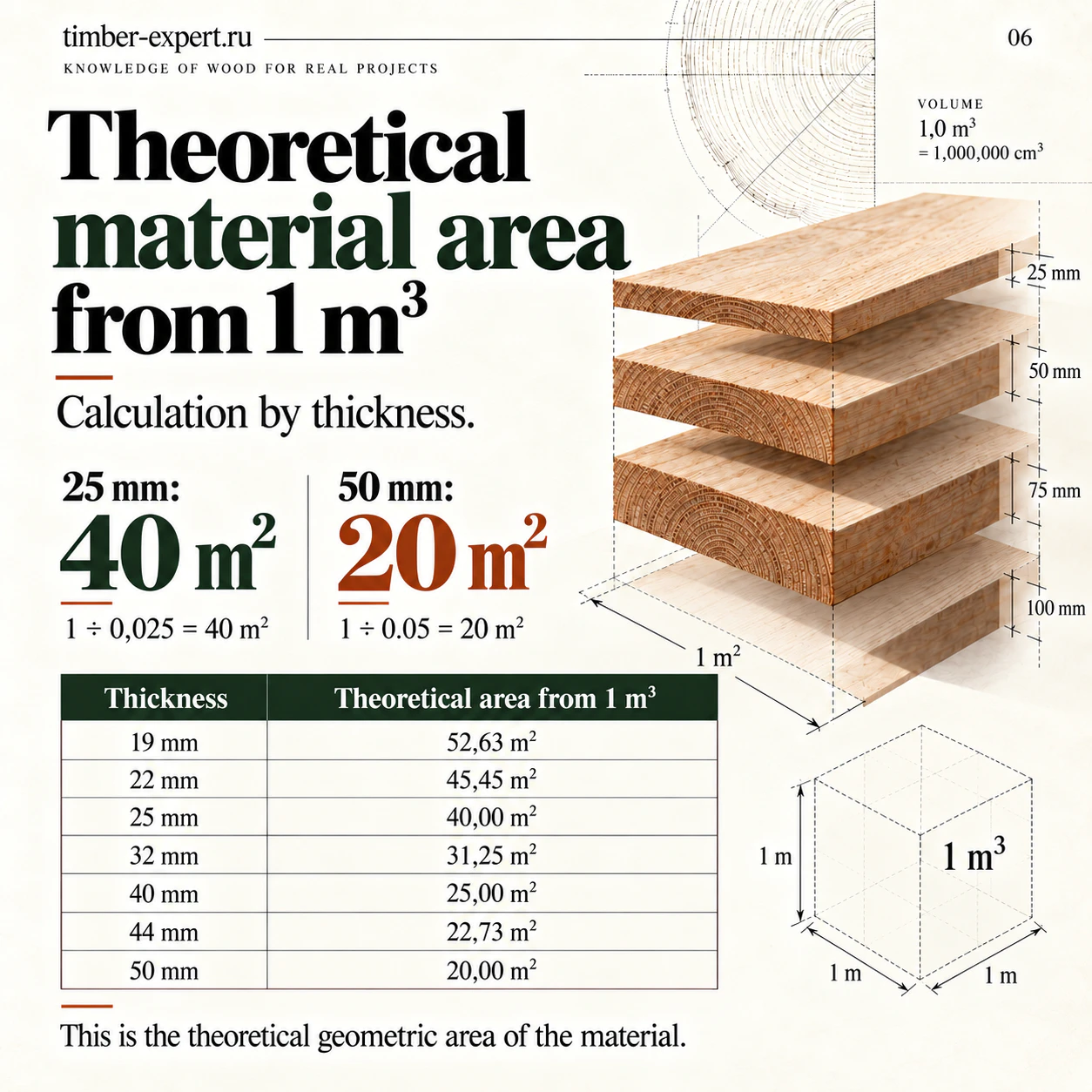
There is another useful way of looking at a cubic metre of material. For a theoretical flat area, the result depends on thickness:
Area = 1 ÷ thickness in metres
At 25 mm thickness:
1 ÷ 0.025 = 40 m²
At 50 mm thickness:
1 ÷ 0.05 = 20 m²
These are theoretical geometric areas. They do not include cutting losses, joints, trimming, waste or the effective coverage width of profiled timber.
Theoretical surface area from 1 m³ of timber by thickness
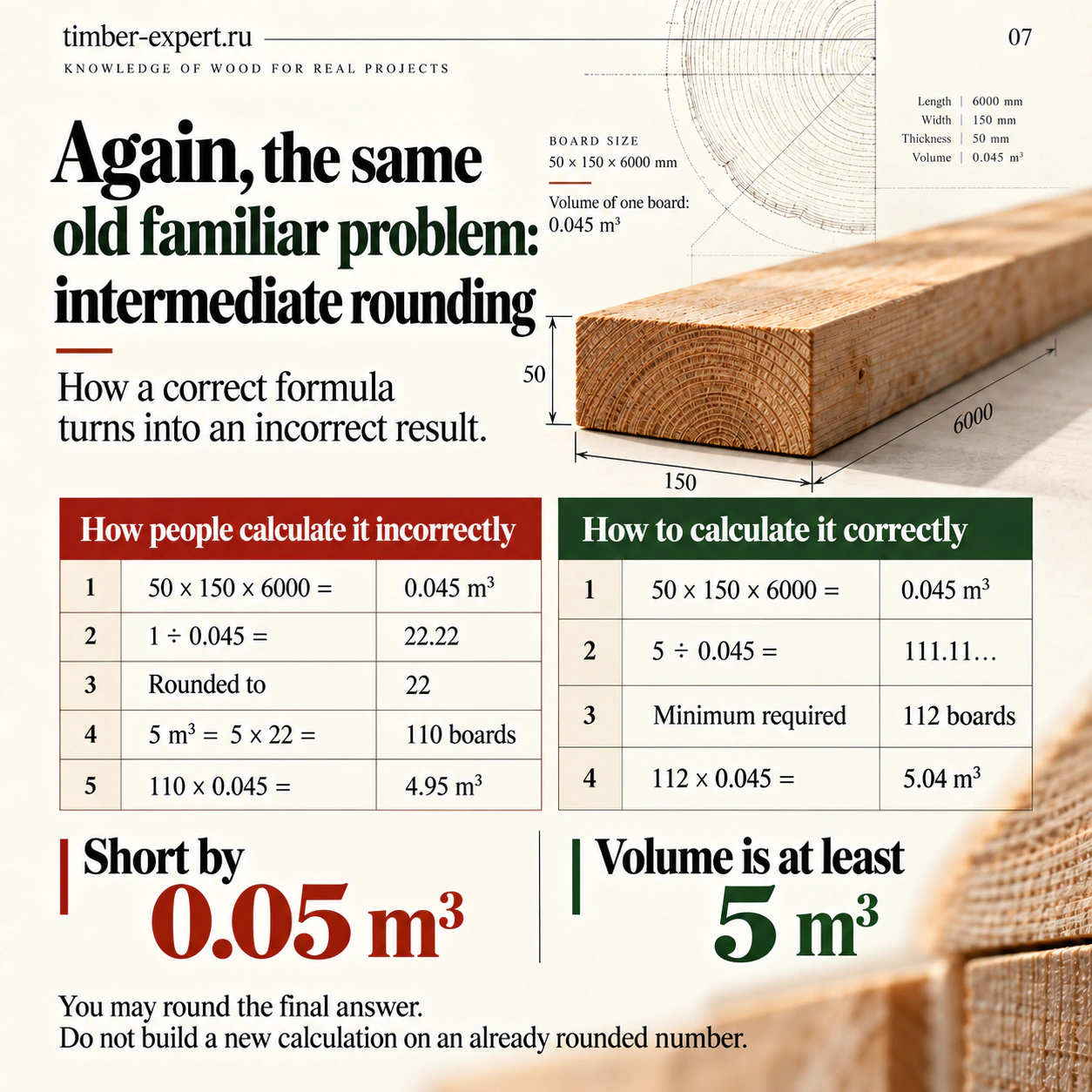
Where Rounding Starts to Cause Errors Rounding itself is innocent. The trouble begins when a rounded number is reused as though it were exact.
Take 50×150×6000 again:
22.22 boards/m³
Round that down to 22 and then calculate 5 m³:
22 × 5 = 110 boards
Looks reasonable.
Check it:
110 × 0.045 = 4.95 m³
Not five.
The better calculation is:
5 ÷ 0.045 = 111.11...
If complete boards are required and the total must be at least 5 m³:
112 boards
Check:
112 × 0.045 = 5.04 m³
The original formula was correct.
The error appeared later, when an intermediate result was rounded.
How intermediate rounding changes the final timber quantity
A useful rule:
Round the final result when necessary. Do not build a new calculation on a rounded intermediate value.
How to Convert a Number of Boards Back into Cubic Metres
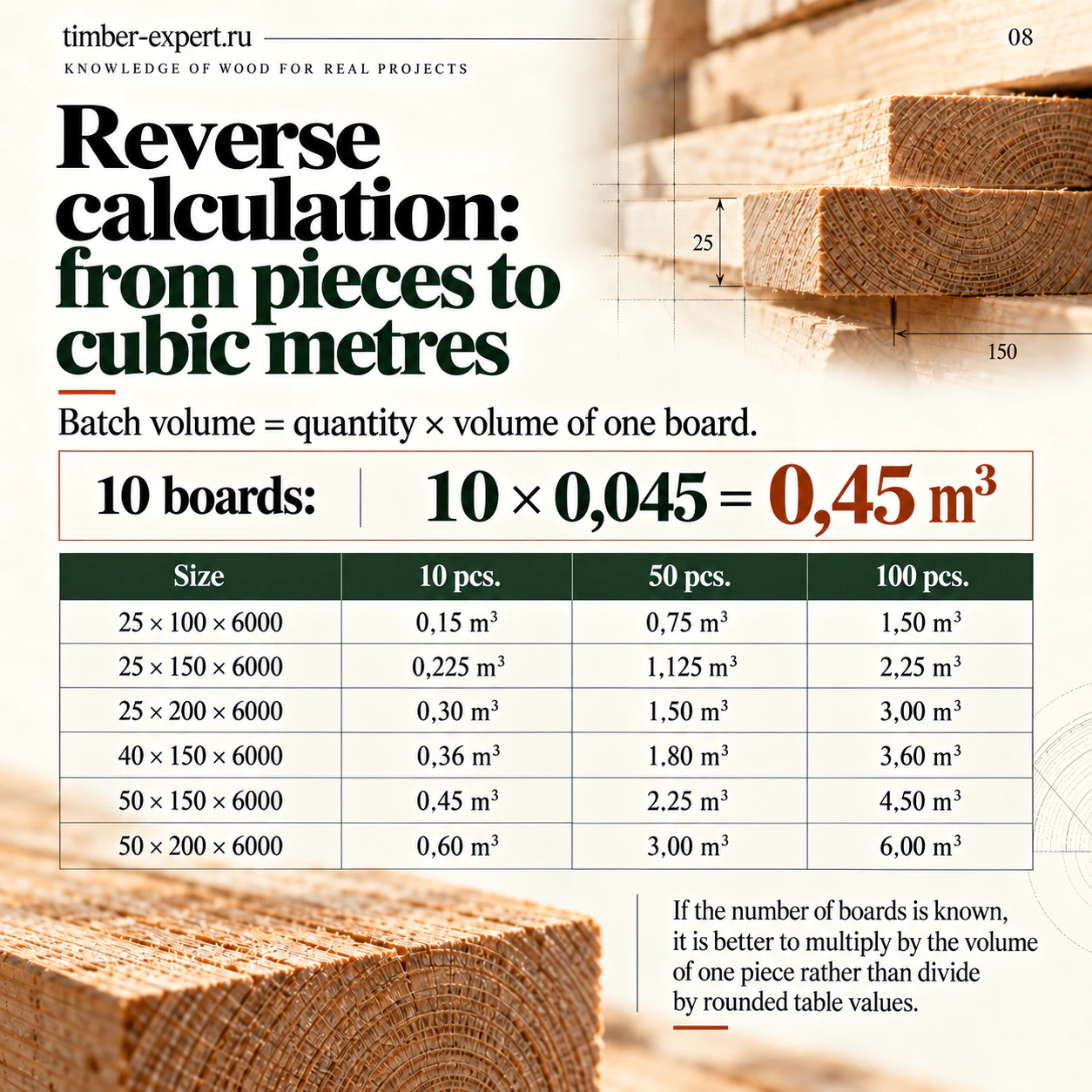
The reverse calculation is even easier:
total volume = number of pieces × volume of one piece
For 50×150×6000 mm timber, one piece is 0.045 m³.
10 boards:
10 × 0.045 = 0.45 m³
50 boards:
50 × 0.045 = 2.25 m³
100 boards:
100 × 0.045 = 4.5 m³
Once the number of pieces is known, there is no need to use a rounded “boards per cubic metre” figure at all.
Converting timber pieces back into cubic metres
Why You Should Not Calculate 150 Boards Using “44 Boards per Cubic Metre”
One 25×150×6000 mm board has a nominal volume of:
0.0225 m³
If you have 150 boards:
150 × 0.0225 = 3.375 m³
Dividing 150 by the rounded value of 44 simply introduces an avoidable error.
One multiplication is both simpler and more accurate.
How to Calculate the Price of One Board from a Cubic Metre Price
The same principle works for pricing.
Suppose, purely as an example, timber costs £500 per m³.
A 50×150×6000 mm board has a volume of 0.045 m³.
So:
£500 × 0.045 = £22.50 per board
Do not divide £500 by the rounded figure of 22.
Twenty-two boards represent 0.99 m³, not exactly one cubic metre.
The general formula is:
price per piece = price per m³ × volume per piece
This works just as well whether your quotation is in pounds, euros, dirhams, yuan or another currency.
Moisture, Drying and Actual Dimensions
All calculations in this guide use nominal geometric dimensions.
Real timber is less obliging than a spreadsheet.
Its actual dimensions may change with drying, moisture content and machining, and finished planed sections may be smaller than their nominal sawn dimensions. Current UK timber calculators make the same distinction between quoted nominal sizes and finished dimensions. Trade Pro
So when comparing quotations from different suppliers, check exactly which dimensions are being priced.
A small difference in section becomes a significant difference when multiplied across a large commercial order.
“25 mm”, “40 mm” and “50 mm Timber” Are Not Enough
Timber is often referred to informally by thickness alone.
But asking:
“How many 50 mm boards are there in a cubic metre?”
does not have one answer.
For example:
- 50×150×6000 → 22.22 boards/m³
- 50×200×6000 → 16.67 boards/m³
- 50×250×6000 → 13.33 boards/m³
Thickness alone is not enough. You need: thickness × width × length
Quick Answers
- 50×150×6000 mm — 22.22 boards/m³; 22 boards = 0.99 m³; 23 boards = 1.035 m³.
- 25×150×6000 mm — 44.44 boards/m³; 44 = 0.99 m³; 45 = 1.0125 m³.
- 40×150×6000 mm — 27.78 boards/m³; 27 = 0.972 m³; 28 = 1.008 m³.
- 50×200×6000 mm — 16.67 boards/m³; 16 = 0.96 m³; 17 = 1.02 m³.
- 25×100×6000 mm — 66.67 boards/m³; 66 = 0.99 m³; 67 = 1.005 m³.
The Three Timber Volume Formulas Worth Remembering
Volume of one piece:
V = thickness × width × length
Calculated pieces per cubic metre:
N = 1 ÷ V
Volume of a batch:
V total = quantity × V per piece
That is really all a timber cubic metre table is doing for you.
It has simply done the arithmetic in advance.
The Important Part
If somebody tells you:
“There are 22 pieces of 50×150×6000 timber in one cubic metre,”
ask what they actually mean. Because mathematically:
22.22 boards/m³ is the calculated ratio;
22 complete boards = 0.99 m³;
23 complete boards = 1.035 m³.
All three numbers are correct. But only if you ask the right question. And if you already know how many boards you have, forget the rounded “pieces per cubic metre” figure altogether. Multiply the quantity by the exact volume of one piece. It is shorter. So, rather conveniently, more accurate.