How Many Timber Beams Are in a Cubic Metre?
How Many Timber Beams Are in a Cubic Metre?
A timber beam looks wonderfully uncomplicated.
Length. Width. Height. Multiply three numbers and the job is done. Unfortunately, this is also how people manage to turn 10 m³ of timber into 9.45 m³ without losing a single beam.
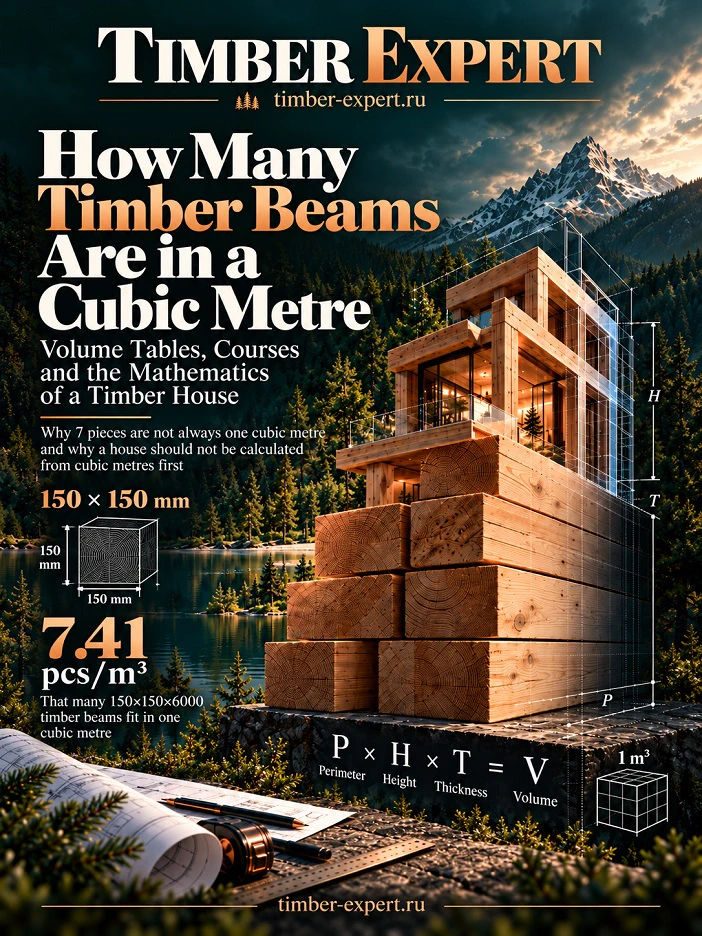
Take a common size: 150 × 150 × 6000 mm
The volume of one beam is: 0.15 × 0.15 × 6 = 0.135 m³
So: 1 ÷ 0.135 = 7.41 beams per m³
Not seven. Not eight.
7.41.
Seven complete beams contain: 7 × 0.135 = 0.945 m³
Eight contain: 1.08 m³
That small distinction becomes surprisingly expensive when the order becomes large.
Timber Volume Table: 6 m Beams
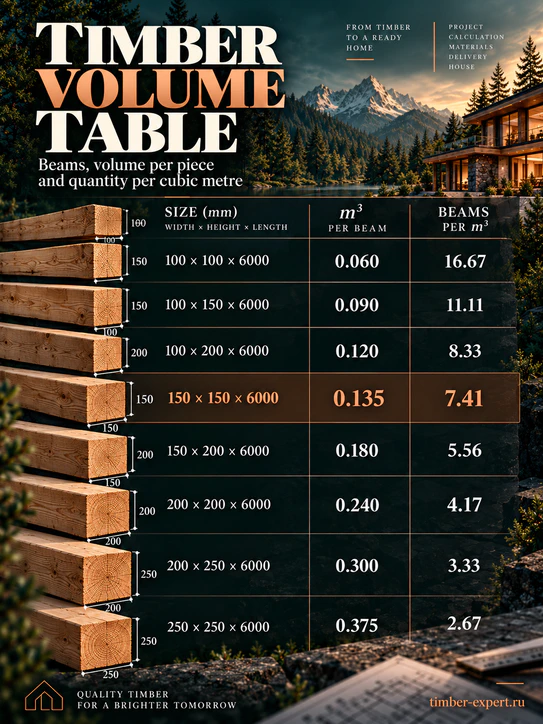
The formula is always the same:
Volume = Width × Height × Length
Use metres, not millimetres.
The Rounding Error That Costs Timber
Suppose you need 10 m³ of 150 × 150 × 6000 mm timber.
Someone remembers: “Seven beams per cubic metre.”
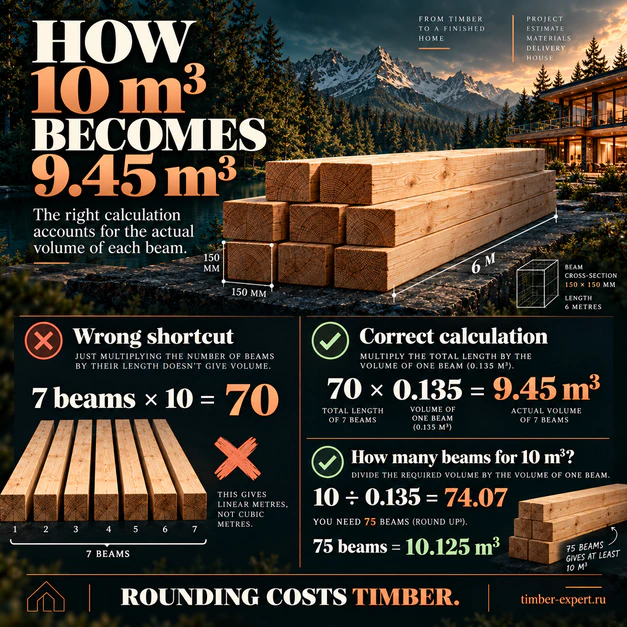
So: 7 × 10 = 70 beams
Looks reasonable.
But: 70 × 0.135 = 9.45 m³
You are short by: 0.55 m³
The correct calculation is:
10 ÷ 0.135 = 74.07
If complete beams are required:
75 beams = 10.125 m³
The rule is simple: Never calculate a large order from a rounded “pieces per cubic metre” number.
Calculate from the exact volume of one beam.
How Many Linear Metres Are in 1 m³?
For construction, linear metres can be more useful than the number of individual beams.
For 150 × 150 mm timber:
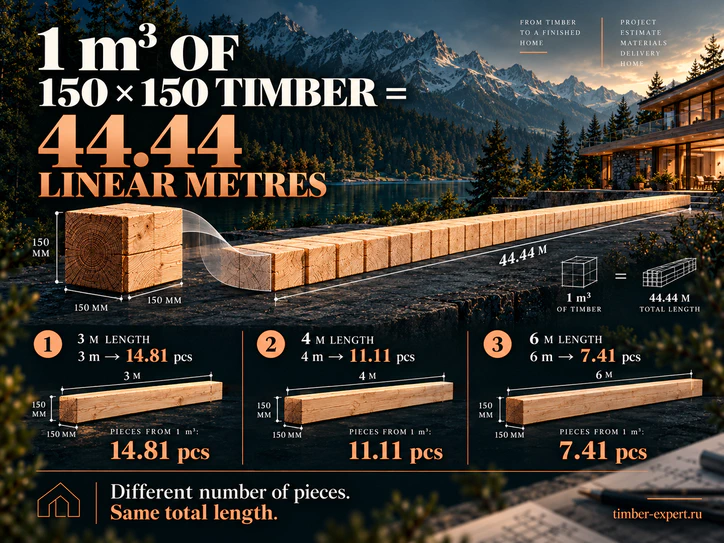
Cross-sectional area: 0.15 × 0.15 = 0.0225 m²
Then:1 ÷ 0.0225 = 44.44 linear metres per m³
It does not matter whether those metres are supplied in 3 m, 4 m or 6 m lengths.
The number of pieces changes. The total theoretical length does not.
A 100 m² House Does Not Tell You How Much Timber You Need
This is where timber calculators often become misleading.
Compare two houses with exactly the same floor area.
10 × 10 m
Floor area: 100 m²
Perimeter: 40 m
5 × 20 m
Floor area: 100 m²
Perimeter: 50 m
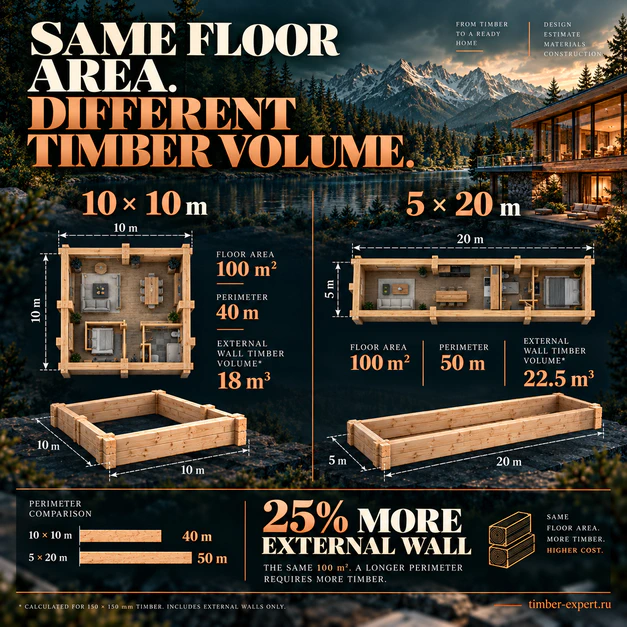
Same floor area.
But the second building has 25% more external wall length.
With 3 m high walls and a wall thickness of 150 mm:
10 × 10 house:
40 × 3 × 0.15 = 18 m³
5 × 20 house:
50 × 3 × 0.15 = 22.5 m³
Difference: 4.5 m³
So a simple rule such as: “X cubic metres of timber per 100 m² of house”
is not a calculation. It is a guess.
Square Houses Use Less External Wall
There is a useful piece of geometry behind this. For the same floor area, a shape closer to a square normally has a shorter perimeter than a long rectangle.
Less perimeter means less external wall.
Less wall means less timber.
This does not mean every timber house should be square.
It simply means that floor area alone cannot tell you the timber requirement.
For a first estimate of solid wall volume:
Wall volume = Perimeter × Height × Thickness
150 mm High Does Not Always Mean 150 mm per Course
Profiled timber introduces another trap.
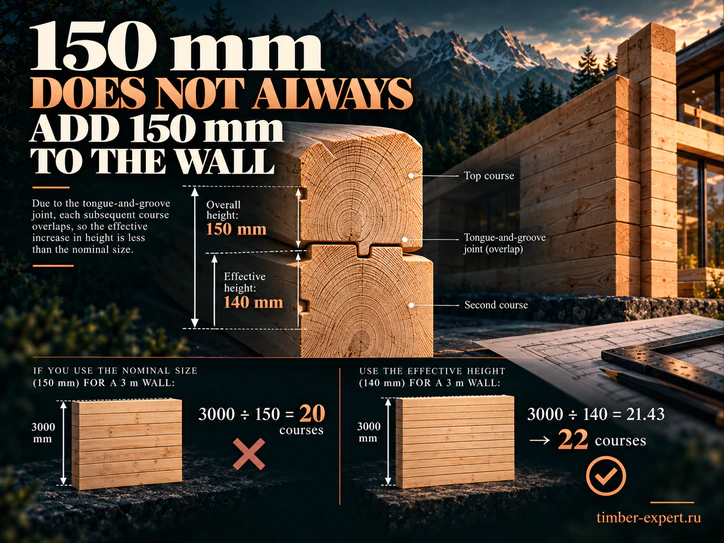
Suppose a wall is 3 m high and the timber is described as 150 mm high.
The obvious calculation is: 3000 ÷ 150 = 20 courses But profiled timber can have an effective course height smaller than its overall height because one profile interlocks with the next. For example, if the effective height is 140 mm: 3000 ÷ 140 = 21.43
So the wall requires: 22 courses not 20.
For profiled timber, always ask the manufacturer for the effective course height. The Five Formulas Worth Saving
- One beam: V = W × H × L
- Beams per m³: N = 1 ÷ V
- Order volume: V = quantity × volume per beam
- Linear metres per m³: LM = 1 ÷ (W × H)
- Solid wall volume: V = perimeter × height × thickness
That is enough for most preliminary timber calculations.
One Last Rule
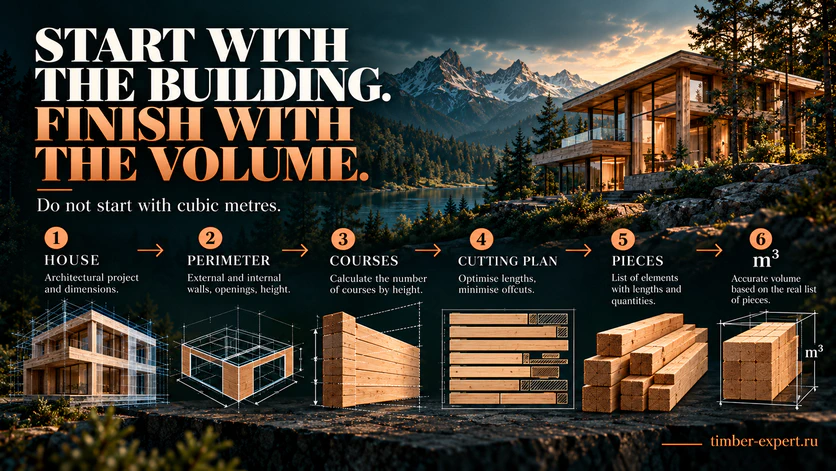
A cubic metre table tells you how much timber is in a beam.
It does not tell you how many beams a building needs.
For that you need: geometry → lengths → cutting plan → pieces → cubic metres
In that order. So if you are calculating saw timber - boards rather than beams, see our separate guide:
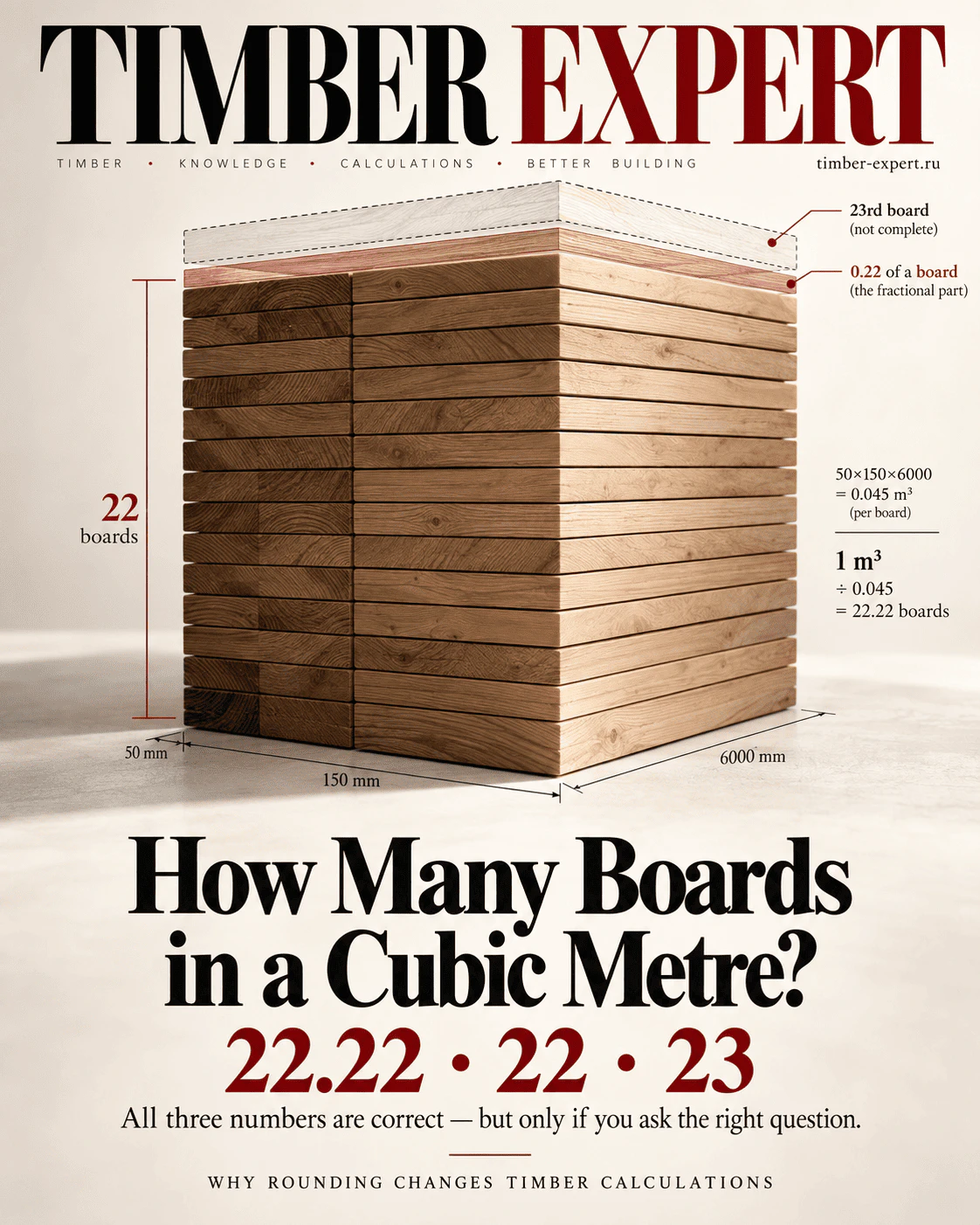
How Many Boards Are in a Cubic Metre? Why 22, 22.22 and 23 Can All Be Correct